Red in Feng Shui: When to Use It, When to Avoid It
Red is the color people ask about most, and the color they get wrong most often. In feng shui, red is fire's color: warmth, energy, visibility, celebration, and joy. A little red wakes a room up and makes it feel alive. A lot of red winds a room up and makes it hard to relax in. This guide is about the difference — where red helps, where it hurts, and how much is enough.
Start with what red does to a human being, because feng shui's claims about red line up closely with what we know about color and mood. Red raises alertness. It draws the eye faster than any other color, which is why stop signs and sale stickers are red. It makes food look more appetizing, which is why restaurants use it. It makes a room feel warmer and smaller, because warm colors appear to advance toward you. None of this is magic; it is how eyes and brains respond to a strong warm color. The feng shui rules about red are mostly rules about managing that response.
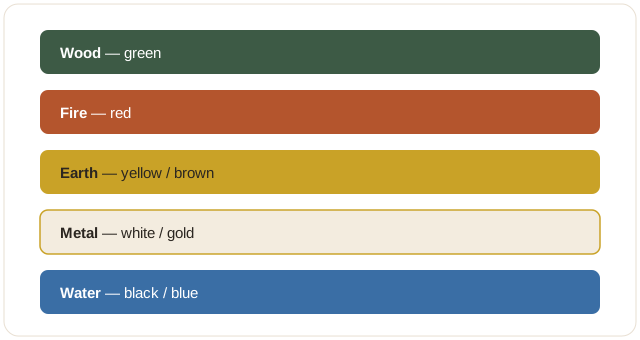
Red belongs to fire, and fire's cycle governs it: wood feeds fire, so green and plants strengthen red; water controls fire, so black and blue calm it; fire feeds earth, so red supports yellow and brown. Red's bagua home is the south, the Fame sector, where visibility is the point. Its shapes are triangles and points. The fire element guide covers the element in full; this guide is about the color itself, in real rooms.
Where red works: dining rooms, entryways, and accents
The dining room is red's best room. Red suits appetite and conversation, and a dining room is where both happen. A red accent wall behind a sideboard, red placemats, a red table runner, a bowl of red fruit — any of these make meals feel warmer and more celebratory. The dining room guide shows how warm tones and low lighting work together; red is the strongest version of that warmth, so use it where the room already aims to be lively.
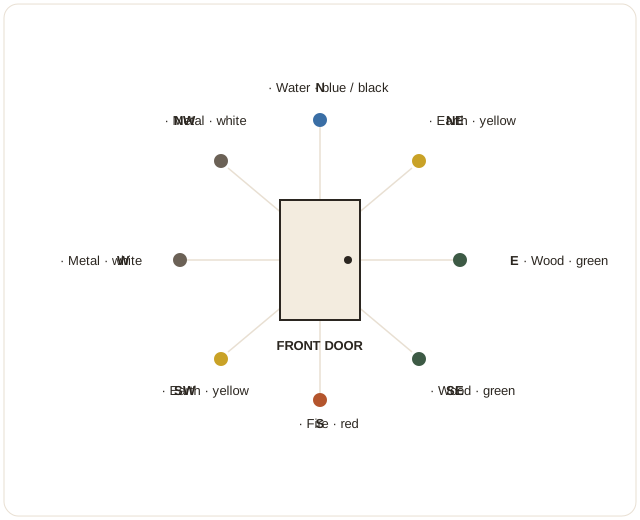
The entryway is red's second-best room, in small doses. A red door is the classic feng shui recommendation, and it works for a plain practical reason: a red door is visible from the street, it says "this home is welcoming," and it makes the entrance easy to find. The front door color guide covers which directions suit red doors and which do not. Inside the entryway, a red console, a red piece of art, or a red doormat gives the same welcoming jolt without repainting anything.
As an accent anywhere, red is superb. A red cushion on a neutral sofa, a red throw on a bed, a red vase on a shelf, a single red chair in a pale room — each draws the eye to exactly one place, which is what an accent is supposed to do. The rule of thumb is that red should be the smallest strong color in the room, not the largest. When red is the accent, it energizes. When red is the background, it overwhelms.
Where red backfires: bedrooms, hot rooms, and overuse
Bedrooms are where red most often backfires. Red bedding, red walls, and red curtains together make it harder to wind down, because red raises alertness — the opposite of what sleep needs. A single red accent in a bedroom is fine, even romantic: a red cushion, a piece of red art. But a bedroom that is predominantly red is a room working against its own purpose. If you sleep poorly in a red bedroom, change the bedding first; it is the cheapest experiment and it often solves the problem.
Hot rooms are the second danger zone. A south-facing room that already gets strong sun, a small room with poor ventilation, a kitchen full of cooking heat — adding red to any of these adds perceived heat to real heat. In a sunny south room, choose cooler tones for large areas and save red for a small accent that can be removed in summer. The same applies to home offices where concentration is already hard: red on the wall behind your screen pulls your eye away from your work.
Overuse is the third problem, and it is the most common. Red on the walls, red sofa, red curtains, red rug, red art — each piece might be beautiful alone, but together they create a room with no resting place for the eye. If your room feels loud, look for the red first. Removing one or two red items usually quiets it more than rearranging the furniture.
Red and the annual stars: check before you paint
Red deserves special caution with the annual flying stars, because two of the most attention-grabbing stars are fire stars. In 2027, the center holds the 9 Purple star and the east holds the 7 Red star. In 2028, the northwest holds the 9 Purple star and the southeast holds the 7 Red star. Adding large amounts of red to those sectors in those years is adding fire to already fiery places. Conversely, the sectors holding the heavy earth stars — the 5 Yellow in the north in 2027 and the southwest in 2028, and the 2 Black in the west in 2027 and the northeast in 2028 — should not be painted red either, because fire feeds earth and would strengthen the heaviness. Check the 2027 chart and the 2028 chart before any red decorating project.
There is one traditional red use worth knowing: small red objects as cures. A red envelope, a red ribbon, or a small red ornament is sometimes placed in a sector as a symbolic fire remedy. These work as accents, not as decoration projects — their small size is the point. A small red object in the right place is a considered choice. A whole red room is a mood you have to live in.
How much red is enough?
As a practical guide: in a living room, aim for red to be about a tenth of what you see — one or two accents. In a dining room, you can go to about a fifth. In a bedroom, keep it to a single accent. On a front door, the whole door can be red, because a door is a small surface with a big job. And in any room, if you are unsure, start with something removable — cushions, a throw, a vase — and live with it for two weeks before committing to paint. Red is easy to add and annoying to remove, so the removable test saves you a repaint.
Red's gift is aliveness. A home with no red at all can feel muted and careful, like a room nobody celebrates in. A home with a little red in the right places feels warm, welcoming, and awake. The goal is not to fear red but to respect it: use it where energy is wanted, keep it small where calm is wanted, and let it be the spark, not the fire.
Go deeper with the book
Feng Shui Made Simple covers every room this way — bedroom, living room, kitchen, office, entryway — with diagrams and a 7-day plan for doing the whole house.
Frequently asked questions
Is red good or bad in feng shui?
Neither, on its own. Red is fire energy: warmth, alertness, and visibility. It is good where energy is wanted — dining rooms, entryways, accents — and bad where calm is wanted, like bedrooms.
Can I paint my bedroom red?
A single red accent wall or red bedding accent is fine, but a predominantly red bedroom makes winding down harder, because red raises alertness. If sleep suffers, change the bedding first.
Is a red front door good feng shui?
Yes, traditionally — a red door is visible, welcoming, and easy to find. Check the front door color guide for which facing directions suit red best.
Should I avoid red in the 5 Yellow sector?
Yes. Fire feeds earth, so red strengthens the heavy earth stars. In 2027 the 5 Yellow is in the north; in 2028 it is in the southwest. Do not paint those sectors red in those years.
How much red should a living room have?
About a tenth of what you see — one or two accents, like cushions or a vase. Start with removable items and live with them for two weeks before committing to paint.