The Luo Pan Compass: What Its Rings Actually Mean
A Luo Pan looks like a riddle: a compass needle at the center, ringed by dozens of circles of Chinese characters, packed so densely they seem decorative. They are not. Every ring is a formula — and once you know what the main rings do, the whole instrument stops being intimidating.
What a Luo Pan is
The Luo Pan (literally "net plate") is the traditional instrument of Compass School feng shui. At its center is a magnetic needle in a small pool, like any compass. Around it, on a rotating plate, are concentric rings of characters. The practitioner rotates the plate until the needle aligns with the ring markings, then reads the characters at the relevant degree to apply a formula.
The number of rings varies by school and maker: a simple model may have 8 rings, an elaborate one more than 30. The most widely used style, the San He (Three Harmonies) Luo Pan, typically carries 20 or more rings, combining Form School and Compass School information on one plate. Other major styles include the San Yuan (Three Cycles) plate, which emphasizes time cycles and the flying stars, and combined plates that carry both.
One historical note explains a common confusion: traditional Chinese compasses were south-pointing. The needle's marked end indicates south, following the Chinese convention of facing south (the emperor faces south; the ideal home faces south). Modern Luo Pans often mark both ends, but older descriptions that say "the needle points south" are following this convention, not describing a broken compass.
The rings that matter most
Working outward from the needle, the rings you will meet on most Luo Pans include:
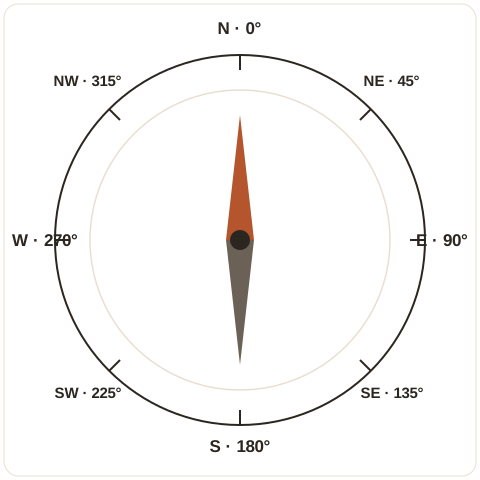
The Earth Plate (24 Mountains). This is the most important ring, and the one every Luo Pan shares. It divides the compass into 24 "mountains" of 15 degrees each: the 8 directions, each split into 3. Each mountain has a name — a heavenly stem, an earthly branch, or a trigram — and this ring is what a practitioner reads to get a precise facing direction. A home "facing South" becomes, on this ring, "facing Bing" or "facing Wu" — a 15-degree band rather than a 45-degree sector. That precision is what separates a Luo Pan reading from a phone reading.
The Eight Trigrams ring. The eight trigrams (bagua) — Qian, Dui, Li, Zhen, Xun, Kan, Gen, Kun — each govern a direction and a family member, an element, and a life area. This ring connects the compass to the bagua map and to the elements: Li (South) is Fire, Kan (North) is Water, Zhen (East) and Xun (Southeast) are Wood, and so on.
The Heavenly Stems and Earthly Branches rings. The 10 heavenly stems and 12 earthly branches are the Chinese calendrical system — the same cycle that names years (the 2027 year is Ding Wei, the Fire Goat). On the Luo Pan, these rings link directions to time: they are how a practitioner connects a direction to a year, a month, or a person's birth data, and how timing advice like Tai Sui is derived.
The 24 Solar Terms and seasonal rings. Some plates mark the solar terms — Lichun, the start of spring, among them — because the feng shui year turns on Lichun, not January 1. The flying stars change on Lichun, and the 2027 chart runs from 4 February 2027 to 3 February 2028 for exactly this reason.
The Five Elements rings. Several rings encode element relationships: which element each direction belongs to, which element controls or feeds which, and how the elements interact in a given sector. These are the lookup tables behind the five elements advice — which colors and materials suit which sector.
The 72 Dragons and 120 Divisions rings. These are finer subdivisions used in advanced Form School work: the 72 Dragons ring divides each 15-degree mountain further for detailed site readings, and the 120 Divisions ring marks auspicious and inauspicious degree bands within each mountain. Beginners can safely ignore both; professionals use them for precise grave and building siting.
How a practitioner actually uses one
The working method is simpler than the plate looks. The practitioner stands at the front door, holds the Luo Pan flat and steady, and waits for the needle to settle. Then they rotate the outer plate — not the needle — until the needle's line aligns with the reference marks on the plate. Once aligned, they read outward along the facing direction: the 24 Mountains ring gives the precise facing mountain, the trigram ring gives the direction's trigram and element, and the other rings give whatever formula is being applied.
For a flying stars reading, the practitioner takes the facing mountain, consults the period (we are in Period 9, 2024–2043), and constructs the home's natal chart — the fixed pattern of stars for that home — which is then combined with the annual chart. For a Form School reading, the same instrument is used outdoors to check the surrounding landforms against the rings' directional information.
Notice what the Luo Pan does not do: it does not decide anything by itself. It is a reference instrument — a set of lookup tables arranged in circles. The judgment is the practitioner's: which ring to read, which formula to apply, and what advice follows. That is why two practitioners with the same Luo Pan can give different advice, and why the instrument's reputation for mystery is overblown. It is a tool, not an oracle.
Do you need one?
For home use, no. Everything on this site — the bagua by compass, the annual flying stars, the facing and sitting analysis — needs only a facing direction, which a phone compass provides. A Luo Pan adds precision (15-degree mountains instead of 45-degree sectors) and access to professional formulas (natal charts, detailed siting), neither of which changes the room-level advice that makes the real difference at home.
Buy or study a Luo Pan if you want to go deeper into the classical system: if you enjoy the theory, if you want to construct natal charts, or if you plan to study with a teacher. A basic San He plate and a good introductory book are enough to start, and the rings described above are the ones to learn first — the 24 Mountains, the trigrams, and the stems and branches. Learn those three and the rest of the plate starts to make sense, ring by ring.
If you do not, nothing is lost. The Luo Pan is the classical tradition's finest instrument, but feng shui's finest results come from simpler things: a bright entry, a calm bedroom, clear paths, and a home that is cared for. Those need no instrument at all — just attention, which is the one tool every tradition agrees on.
Go deeper with the book
Feng Shui Made Simple explains the compass, the bagua, and the elements in plain English, with a room-by-room walkthrough, 9 original diagrams, and a 7-day reset plan.
Frequently asked questions
What is a Luo Pan?
A Luo Pan is the traditional Chinese feng shui compass: a magnetic needle at the center, surrounded by concentric rings of characters that encode directions, elements, trigrams, and formulas. Practitioners use it to take precise compass readings and to apply Compass School formulas.
Do I need a Luo Pan for home feng shui?
No. A phone compass gives you the facing direction, which is all you need for the bagua by compass, the annual flying stars, and facing-versus-sitting analysis. A Luo Pan is for professional-level work and for students of the classical system.
How many rings does a Luo Pan have?
It varies by school and maker, from around 8 rings on a simple model to more than 30 on an elaborate one. The most widely used style, the San He (Three Harmonies) Luo Pan, typically has 20 or more rings.
Why does the Luo Pan needle sometimes point south instead of north?
Traditional Chinese compasses were south-pointing: the needle's marked end indicates south, following the Chinese convention of facing south. Modern Luo Pans often mark both ends, but the south-pointing tradition explains why older descriptions say the needle points south.