Missing Corners: The Complete Guide (all 8 directions)
Most homes are not perfect rectangles. A notch out of one corner for a garage, a stairwell, or a neighbour's extension leaves the floor plan L-shaped or T-shaped — and in feng shui, that missing piece matters. Each direction of the home is tied to an area of life through the bagua, so a missing corner is read as a missing piece of that area. Whether or not you accept the symbolism, the practical point stands: a home with a chunk missing feels different from a complete one, and the missing part is usually the part you notice.
Before fixing anything, work out whether you actually have a missing corner. Lay the bagua over your floor plan — the floor plan guide shows how — and look at each of the eight outer sectors. The common rule of thumb is this: a sector counts as missing when more than one-third of that sector's area is absent from the floor plan. Less than that is a dent, not a missing corner, and dents rarely need attention. This is a rule of thumb, not a scientific measurement, but it stops you chasing every small notch in an old house.
Also check the shape honestly. Many homes that look L-shaped on paper are really two rectangles joined together, and the 'missing' piece is actually the garden or a courtyard that the house wraps around. A courtyard that is used and loved is not a hole in the home — it is an outdoor room. The missing-corner concern applies to pieces that are simply absent: where the building stops and nothing replaces it.
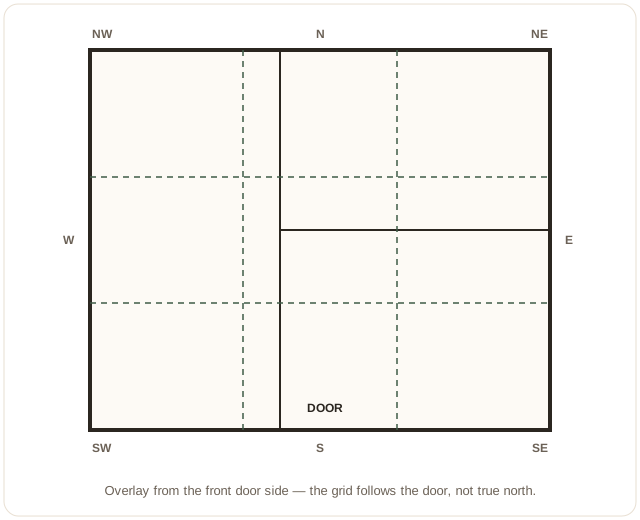
North: Career, Water
The north sector of the bagua is Career, element Water. A missing north corner is traditionally linked to feeling stuck at work or unsure of direction — and practically, it often means the home lacks a quiet, inward-facing space, since north rooms are the cool, dim ones. The fix: bring Water in gently. A small water feature, a mirror, or a picture of water in the remaining north wall area, in dark blue or black tones, re-marks the sector. Keep it calm — north is the quiet direction, so a busy, bright treatment works against the point.
Northeast: Knowledge, Earth
Northeast is Knowledge, element Earth. Tradition links a missing northeast to interrupted study or muddled decisions; practically, it is often the corner where a reading nook or study would have gone. The fix: an Earth anchor. A heavy ceramic pot, a stone object, or a bookshelf with real books on the northeast wall gives the sector weight and a purpose. If you study or read at home, put even a small part of that activity here — a chair and a lamp in the nearest northeast space — so the area has a job again.
East: Health & Family, Wood
East is Health and Family, element Wood. A missing east corner is the one people notice most in the morning, because east is where the day's first light would come in. The fix: living Wood. A healthy potted plant or a small tree on the east side, in greens or natural wood tones, restores the growing, lively quality of the sector. The plants guide covers which plants suit which rooms — pick something you will actually water, since a dying plant in a 'fix' position is worse than no plant at all.
Southeast: Wealth, Wood
Southeast is Wealth, element Wood. This is the sector most often asked about, and the one where expectations need the most care: no plant or object creates income. What a missing southeast does practically is remove the home's most light-filled, outward-growing corner, and that can make a home feel as if it has no room for growth. The fix: healthy Wood again — a thriving plant, wooden furniture, or green accents — plus light. A bright, clean, well-lit southeast corner, even a partial one, reads as a home with room to grow. Keep it tidy: a missing sector that is also a dumping ground is the worst combination.
South: Fame, Fire
South is Fame, element Fire. A missing south corner traditionally touches reputation and visibility — being seen and recognised. Practically, south is the sunniest side, so a missing south piece often means the home loses its brightest room. The fix: Fire and light. A good lamp, candles used safely, or red and warm orange accents on the south wall bring back brightness and warmth. If the missing south piece takes the main window with it, prioritise daylight in the nearest south room — keep that window uncovered during the day.
Southwest: Love, Earth
Southwest is Love, element Earth — relationships and partnership. A missing southwest is the one couples ask about most, and the practical reading is straightforward: the home loses the warm, grounded corner where a couple would naturally settle. The fix: Earth and pairs. Ceramic or stone objects, warm earthy colours, and things in pairs — two cushions, two bedside lamps, two matching chairs — on the southwest side. The love guide goes deeper on the southwest and the bedroom, but the principle here is the same: make the remaining southwest feel settled and shared, not empty.
West: Creativity & Children, Metal
West is Creativity and Children, element Metal. A missing west corner traditionally touches creative projects and children's wellbeing; practically, it is the corner that catches the evening light, so losing it can make late afternoons feel flat. The fix: Metal and light. A metal object, a round shape, or white and metallic tones on the west wall, plus a lamp that comes on in the late afternoon to replace the lost evening sun. If children use the home, give their creative things — drawing, music, building — a place near the west side, even a small one.
Northwest: Helpful People, Metal
Northwest is Helpful People, element Metal — mentors, friends, and the people who open doors. A missing northwest is traditionally linked to feeling unsupported; practically, it often means the home lacks a welcoming guest space, since northwest rooms suit visitors. The fix: Metal again, with a guest-friendly touch. A metal-framed picture, a tidy guest chair, or a small table kept ready for a visitor on the northwest side makes the sector serve the purpose tradition assigns it: a place for helpful people to land.
The centre: Wellbeing, Earth
The bagua's ninth sector is the centre — Wellbeing, element Earth — and it is rarely 'missing' in the same way, because the centre is inside the house by definition. But it can be blocked: a centre filled with a staircase, a bathroom, or a pile of storage is the indoor version of the same problem. The fix is the same as for every other sector, only more important: keep the centre clear, clean, and uncluttered. The small spaces guide has the clear-centre habit in miniature, and it applies to houses too.
How to apply a fix without overdoing it
Three rules keep this sane. First, fix only the sectors that are genuinely missing by the one-third rule — chasing every dent turns the home into a shrine. Second, one fix per sector is enough; a plant plus a mirror plus a crystal in the same corner is clutter, not feng shui. Third, choose the fix you will maintain. A plant you water beats a symbol you ignore, and a lamp you switch on beats a colour you painted and forgot.
And keep expectations honest. A missing corner fix changes how a room looks, feels, and gets used — that is real, and it is enough. It does not rewrite a career, a relationship, or a bank balance, and any source that promises otherwise is selling something. What it does do is return a neglected piece of the home to use, and a home that is fully used feels whole in a way that a home with a dead corner does not. Start with the sector you noticed first — that is usually the one that matters most to you, and the one whose fix you will actually keep up.
Go deeper with the book
Feng Shui Made Simple covers every room this way — bedroom, living room, kitchen, office, entryway — with diagrams and a 7-day plan for doing the whole house.
Frequently asked questions
How do I know if a corner is really missing?
Lay the bagua grid over your floor plan. The common rule of thumb is that a sector counts as missing when more than one-third of that sector's area is absent. Smaller notches are dents, not missing corners, and usually need no fix.
Which missing corner matters most?
The one you notice. In practice, the missing piece that bothers you is the one whose room or light you miss, and its fix is the one you will maintain. If you want a traditional ranking, southeast (wealth) and southwest (love) are the sectors people ask about most.
Can I fix a missing corner from outside the house?
Yes, and it often works better. A plant, a light, or a stone marker in the garden where the missing piece would have been re-marks the sector in the full plot, and it is easier to maintain than an indoor symbol squeezed into a wall.
Does a missing corner affect an apartment the same way?
The same reading applies, using the apartment's own floor plan rather than the whole building's. Renters can use the same fixes — plants, lamps, colours — since none of them require structural changes. See the renters' guide for the full approach.
Is a protruding corner the opposite problem?
Roughly, yes: where a missing corner is an absence, a protruding corner is an excess — a room that sticks out beyond the rectangle. It has its own reading and its own fixes, covered in the companion guide to protruding corners.