Feng Shui for Wealth: Beyond the Wealth Corner
If you search for wealth feng shui, you will find a hundred objects to buy: coins, toads, bowls, trees made of crystal. This guide starts somewhere else — with the honest statement that no arrangement guarantees wealth, income, or financial success.
What your home can do is support the habits that build wealth: paying attention to money instead of avoiding it, keeping the place where you handle money calm and organized, cooking at home more often, and welcoming opportunity through a front door that works. That is less exciting than a magic object, and far more useful. Wealth, in the practical sense, is mostly a set of repeated small decisions — and a home can make those decisions easier or harder, several times a day.
The wealth corner, properly understood
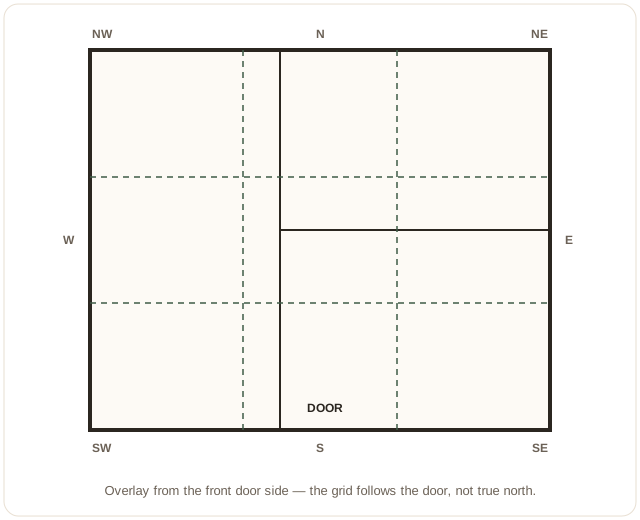
In the bagua map, wealth is the southeast sector, and its element is Wood. Wood is growth: green, tall, alive, reaching upward. The southeast guide (southeast sector) covers this corner in detail, and the 2027 wealth corner article covers its annual star. But here is the key point: the southeast is one sector of nine, and treating it as the whole of wealth feng shui is like treating one muscle as the whole of fitness. It matters, and it is not enough.
Find your southeast with a compass and a floor-plan overlay — the bagua map guide explains how — then give it the basics: clean, uncluttered, well-lit, with something green and alive if the light allows. A healthy plant is the classic southeast object, and the reason is practical as much as symbolic: a plant you water weekly is a small repeated act of care for growth, and it makes the corner visibly alive. A dead plant does the opposite, so if you kill plants, use a green textile, green art, or a wooden object instead. The corner should look tended, not decorated and forgotten.
The entrance: where opportunity arrives
In feng shui, the front door is called the mouth of qi — the place where energy, people, and opportunity enter the home. For wealth, the entrance matters more than any single corner, because it is where work arrives: clients, deliveries, visitors, post, ideas. An entrance that is hard to find, dark, blocked by shoes and boxes, or guarded by a sticking door quietly discourages all of it.
The fixes are unglamorous and effective: a door that opens fully, a working light, a clear path, a house number that is visible, a doormat that is clean. Inside, the entryway guide covers the landing zone — a place for keys, post, and bags so they do not migrate to the kitchen table. If you work from home, the entrance matters twice over: it is the threshold between your private life and your earning life, and keeping it distinct helps you treat work hours as real.
The kitchen: where money is kept or lost
The kitchen is the second wealth room, and the reason is the household budget. A kitchen that is pleasant to cook in saves real money: home cooking is usually far cheaper than takeout, and a kitchen you enjoy using is a kitchen you actually use. The kitchen guide covers layout and stove position, but for wealth the essentials are simpler — a working stove with all burners in use (tradition says a stove you actually cook on symbolizes a household that provides for itself), a clean fridge you can see into, and clear counters so cooking does not feel like a chore you avoid.
Fix leaks promptly, in the kitchen and everywhere else. This is partly symbolic — tradition reads dripping water as money leaking away — and partly plain economics: a leaking tap wastes water and money every day. A home that is maintained is a home whose owner is paying attention, and attention is the root wealth habit.
The money desk: a place for financial attention
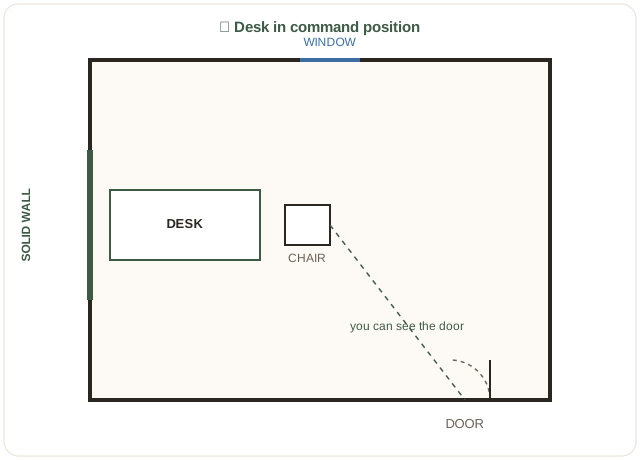
Most wealth advice fails at the same point: people avoid looking at their money. Give that task a place. It does not need to be a grand study — a corner of a desk, a drawer, a folder, and a regular time will do. Sit in the home office command position if you can: facing the door with a solid wall behind you, so you can see who comes in and your back is protected. The office guide and the desk diagram below show the setup.
Then attach a habit to the place: once a week, sit there for twenty minutes and look at your accounts, your bills, and your spending. No phone, no television, no multitasking. A desk that is reserved for this — clear, with your papers filed rather than piled — makes the twenty minutes tolerable, and tolerable is what gets repeated. Wealth is built by people who look at their money regularly, not by people who buy the right ornament and never look again.
Clutter, and what it costs
Clutter costs money in three quiet ways. First, you buy duplicates of things you already own but cannot find. Second, you pay late fees on bills buried in piles. Third, you avoid the rooms where the clutter lives, which means you avoid the desk, the kitchen, and the entrance — the three wealth rooms. Clearing clutter is therefore a financial act, not just a tidy one. Start with the surfaces where money is handled: the desk, the kitchen table, the entryway table. One clear surface each, maintained daily, beats a whole-house purge that collapses in a week.
The same logic applies to broken things. A broken appliance you keep "meaning to fix" is a small daily reminder of unfinished business. Fix it, replace it, or let it go — the decision itself is worth more than the object. And keep the southeast, like every sector, free of broken objects: a wealth corner full of things awaiting repair sends the opposite message from the one you want.
What not to do
Do not spend significant money on wealth objects before the free fixes are done. A crystal tree in a cluttered, dark corner with a sticking front door is decoration, not feng shui. Do not borrow money to buy feng shui cures — that reverses the entire purpose. Do not rearrange your home around a single year's star: the southeast's annual star changes, but your entrance, kitchen, and money habits are permanent. And do not treat any of this as investment advice or a promise. If someone tells you an arrangement will bring a specific sum of money by a specific date, they are selling you something, not teaching you feng shui.
Start this week with four free steps: clear the front door path, clean the southeast corner, cook three meals at home, and sit at your money desk for twenty minutes. None of these will make you rich. All of them make wealth-building behavior easier, and that — repeated for months — is the only wealth method that has ever reliably worked.
Go deeper with the book
Feng Shui Made Simple covers every room this way — bedroom, living room, kitchen, office, entryway — with diagrams and a 7-day plan for doing the whole house.
Frequently asked questions
Where is the wealth corner in feng shui?
In the bagua map, wealth is the southeast sector, whose element is Wood. Some schools also use the far-left corner from the front door. The southeast is the more consistent choice: find it with a compass and a floor-plan overlay, then keep it clean, green, and well-lit.
Will a money plant or a wealth bowl make me rich?
No. No arrangement guarantees wealth or income. A healthy plant or a tidy desk can support the habits that build wealth — attention, patience, and regular review of your money — but the object itself does not create money. Be wary of anyone selling an object that promises it will.
What colors are good for wealth feng shui?
Wood greens suit the southeast, supported by Water colors (black and blue), because Water produces Wood. Gold accents are traditional symbols of wealth, but a calm green and a tidy room do more work than a gold ornament in a cluttered corner.
My southeast sector is a bathroom. Is my money doomed?
No. Keep the bathroom clean, fix leaks promptly, and keep the door closed. Then put your wealth effort where it actually lives: your entrance, your kitchen, and the place where you handle money. A well-used bathroom is not a financial curse.