Feng Shui for Study and Exams
Exams are won in the weeks before them, in quiet rooms, at desks where attention stays put. A study space cannot learn the material for you — no arrangement guarantees passing an exam or any grade — but it can make the hours of learning easier, longer, and less miserable.
The difference between a good study space and a bad one is rarely money. It is position, light, and the number of things competing for your eyes. A desk facing the door with a wall behind you, a lamp that lights the page without glare, a surface with only the current subject on it, a phone in another room: these cost almost nothing, and they are worth more than any "study crystal" ever sold. This guide covers them in order of impact.
The desk: command position for concentration
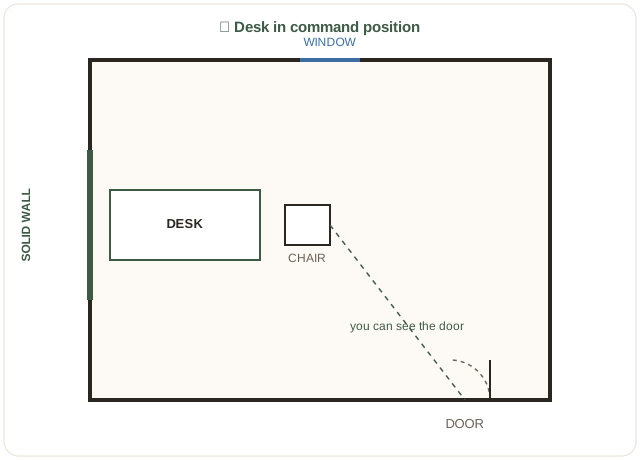
Put the study desk in the command position: facing the door, solid wall behind you. The reason is the same as for any desk — when you can see who enters, you stop spending attention on guarding your back — but for study it matters even more, because study attention is fragile. A single startle, a person appearing silently behind you, can break a train of thought that took twenty minutes to build. The home office guide shows the setup, and it applies exactly to study desks.
If the room forces a wall-facing desk, make it the best wall-facing desk you can: pull the desk out so you are not nose-to-wall, hang a picture with depth (a landscape, a street scene) at eye level for rest breaks, and keep the door visible in a mirror if a mirror can be placed without reflecting glare onto your work. Never study with your back to an open door in a busy household if any alternative exists — every passing footstep becomes a distraction you have to actively ignore.
Light: the study tool you already own
Bad light ends study sessions early: headaches, eye strain, and the sleepy feeling of a dim room. Natural daylight is best, ideally from the side so it lights your page or screen without shining into your eyes. If you study at night, layer your light: a focused desk lamp for the work surface, plus a softer room light so the page is not a bright island in darkness. The contrast between a bright screen and a dark room is what tires eyes fastest, and the light guide explains layering simply.
Color temperature matters too. A cool-white bulb suits focused daytime study; a warm bulb suits evening wind-down reading. If your lamp has adjustable temperature, use it — cool by day, warm after sunset, so your body clock is not told it is noon at midnight. And keep the study light off the bed if you study in a bedroom: light discipline is part of sleep discipline, and sleep is where memory consolidates.
The northeast: knowledge in the bagua
In the bagua map, knowledge and self-cultivation belong to the northeast sector, whose element is Earth — yellow, beige, and brown tones, square shapes, and the quality of stillness and grounding. If you can place a study corner, a bookshelf, or a reading chair in the northeast, do so; the northeast sector guide covers the details. Keep the northeast quiet and tidy: this is a sector for depth, not display, so a calm shelf of real books you are actually reading beats a decorative display.
Earth is produced by Fire, so a warm lamp or a terracotta accent supports the northeast gently. Keep strong Wood — tall plants, large green expanses — in check here, since Wood controls Earth. But do not overthink the sector: the desk position and the study routine below matter far more than the sector's color. A northeast painted perfectly in which you never sit is worth less than a kitchen-table corner where you study daily.
The surface: only the current subject
A study desk should hold the current subject and nothing else. Every extra object — another subject's textbook, yesterday's notes, a charger, a snack wrapper — is a small invitation to switch tasks, and task-switching is the great enemy of learning. At the start of a session, clear the desk completely, then put back only what this session needs. At the end, clear it again. The two minutes this takes are repaid in the first ten minutes of focused work.
Storage belongs off the desk, not on it: a shelf, a drawer, a box per subject. Label them. The goal is a desk you can clear in sixty seconds and restore in sixty seconds, so that starting to study never requires a prior cleaning project — because a cleaning project before studying is how studying gets postponed until tomorrow. Keep the phone out of the room during study blocks, or at minimum face-down, silenced, and out of arm's reach. Willpower is a poor lock; distance is a good one.
The room around the desk
Sound: if the household is noisy, use the quietest room available, and consider earplugs or steady background sound rather than music with lyrics, which competes with reading. Air: open the window between sessions, even briefly; stale air makes a room feel sleepy. Temperature: slightly cool beats warm for alertness — a warm, stuffy room is a nap waiting to happen.
Breaks need a place too. Stand up, leave the desk, look out the window or walk to another room for five minutes every half hour or so. Do not take breaks at the desk scrolling a phone — that is not rest, it is a different kind of screen work, and you will return to study already tired. A study corner with a window view gives breaks somewhere to go without leaving the room: eyes on distance, mind off the page, for a few minutes.
Sleep: the part of study nobody markets
The single most effective study aid is sleep, and the bedroom is where study feng shui meets sleep feng shui. If you study in your bedroom, separate the zones clearly: desk facing away from the bed, study materials put away at night, and no studying in bed, ever. The bedroom guide and the bed direction guide cover the sleep setup. Keep the last hour before bed screen-light and study-free where possible: review notes earlier in the evening, then let the mind settle. Cramming until 2 a.m. feels productive and tests terribly, because memory consolidates during sleep, and a night without sleep is a night without consolidation.
A study routine for the space
- Before: clear the desk to one subject, phone out of reach, water and lamp ready.
- During: work in focused blocks with real breaks away from the desk; keep the door in view.
- After: clear the desk, file the notes, and write tomorrow's first topic on paper.
- Weekly: tidy the northeast corner and the bookshelf; remove anything you are no longer studying.
Exams reward the student who shows up daily, in a space that lets attention stay put. Build that space — one desk position, one lamp, one clear surface — and then do the work in it. The room will not pass the exam for you. It will make passing a little less hard, day after day, which is the most any room can honestly offer.
Go deeper with the book
Feng Shui Made Simple covers every room this way — bedroom, living room, kitchen, office, entryway — with diagrams and a 7-day plan for doing the whole house.
Frequently asked questions
Where should a study desk face?
Face the door of the room with a solid wall behind you — the command position. You can see who enters without turning, which keeps your attention on your work. If the desk must face a wall, leave enough space to lean back and hang something with depth to look at during breaks.
What is the study sector of the bagua?
The northeast sector, associated with knowledge and self-cultivation, whose element is Earth. Keep the northeast of your home quiet, tidy, and well-lit, and use it for reading, study, or a bookshelf if you can.
Can feng shui help me pass an exam?
No arrangement guarantees passing an exam or any grade. What a good study space can do is support the real work of preparation: longer focus, better sleep, regular review, and less time lost to distraction. The studying does the passing.
Is it bad to study in the bedroom?
It is workable if you separate the zones: a desk that is clearly for study, facing away from the bed, with study materials put away at night. Never study in bed — your body learns to associate the bed with effort, and both sleep and study suffer.