Feng Shui for Marriage and Partnership
A home built for two feels different from a home built for one with a guest in it. The difference is in a hundred small equalities: two bedside tables, two chairs at the table, two places to put things down, two people who can move through the rooms without negotiating.
This guide is about those equalities, and about the rooms where a partnership actually lives — the bedroom, the dining table, and the places where conversation happens. One honest statement first: no arrangement guarantees a relationship outcome, and a room cannot fix what needs conversation, counseling, or honest decisions. What a shared, equal home can do is remove daily friction and create more moments of ease — and ease is where good partnerships breathe.
The bedroom: equal on both sides
The most important partnership rule in feng shui is also the most practical: both partners should have equal access to the bed. That means the bed is not pushed against a wall, both sides have room to get in and out, and each side has a bedside table and a lamp. The partner against the wall — who must climb over the other at night, who has nowhere to put a glass of water or a book — is daily reminded that the room was not really designed for them. The bedroom guide covers the full layout, and the love guide covers the romantic side of the same room.
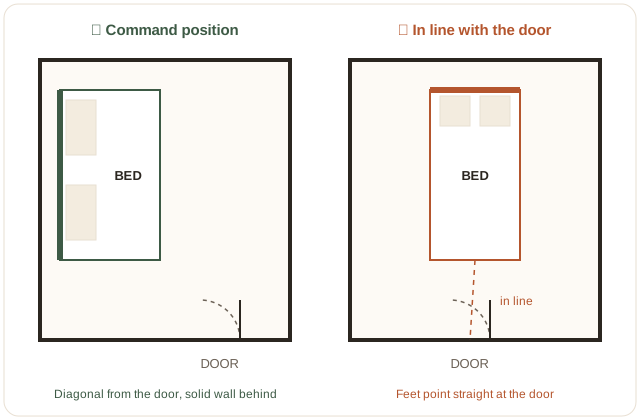
Bed position follows the command position: facing the door, headboard against a solid wall, so both partners can see who enters and neither sleeps with an exposed back to the room. Keep work out of the bedroom where possible — a desk full of deadlines beside the bed imports the office into the most private room of the house, and it does so for both partners, not just the one who works there. And keep the bedroom for rest and togetherness: the TV guide explains why a television in the bedroom costs couples conversation as well as sleep.
Pairs, not singles
Tradition recommends pairs in the partnership areas of the home: two cushions, two candles, two chairs, artwork showing two figures or two trees rather than a lone figure. The practical reading is simple: a home full of single chairs, single settings, and solitary images quietly rehearses singleness, while pairs rehearse togetherness. You do not need to buy anything — look at what you already have and notice where the single items cluster. Two bedside lamps instead of one, two mugs on the shelf instead of a lone favorite, a photograph of the two of you instead of only individual portraits.
Keep the pairs genuine rather than decorative. Two chairs that nobody ever sits in together are set dressing; two chairs angled toward each other by a window, with a small table between them for tea, are an invitation. The best partnership object in a home is a place where two people actually sit together, daily, without a screen between them.
The southwest: love in the bagua
In the bagua map, love and partnership belong to the southwest sector, whose element is Earth — warm yellow, beige, and brown tones, square shapes, and the quality of grounding and receptivity. Keep the southwest tidy, warm, and welcoming: earth tones, soft light, and pairs of objects. Fire produces Earth, so warm accents — a terracotta pot, a soft red cushion, candlelight — support the southwest gently. The southwest sector guide covers the sector in detail.
As with every sector, the room matters more than the symbol. If your southwest is a living room, make it a room for conversation (see below). If it is a bedroom, make it the equal bedroom described above. If it is a bathroom or kitchen, keep it clean and in good repair and put your partnership effort where you actually spend time together. A southwest full of Earth-colored ornaments in a room nobody uses is decoration; a southwest that is simply a pleasant, well-kept room is feng shui.
Rooms for conversation
Partnerships live or die by conversation, and conversation needs places. The dining table is the first: a table where both partners eat together, facing each other, without screens, at least once a day. The dining room guide covers table shape and the host seat; for couples, the key detail is facing each other rather than sitting side by side in front of a television. Face-to-face seating is how people actually talk, and how they notice when something is wrong.
The living room is the second: seating arranged for conversation, not for television. Chairs angled toward each other, a sofa that both partners can sit on comfortably without one person exiled to a bad seat, a coffee table that holds tea rather than clutter. The living room guide covers the arrangement. If the television dominates the room, agree on screen-free time together — even thirty minutes — and protect it the way you would any other appointment. Conversation is a habit, and habits need a time and a place.
Shared space, personal space
Equality does not mean sameness. A good partnership home has shared space and personal space: a shared bedroom and dining table, but also a chair, a shelf, or a corner that belongs to each partner alone. One partner's books, the other's plants, a desk each if space allows — these are not divisions, they are respect. Couples who have nowhere to be alone together in a home eventually seek aloneness by withdrawing from each other, which is worse.
The same balance applies to decisions about the home. Rearranging for partnership should be a joint project, not one partner's surprise renovation. Talk about what each of you wants from the bedroom, the living room, the dining table — and notice where your answers differ. The conversation about the home is often the conversation the partnership needed anyway, and the home is a safe, concrete place to have it.
What to remove
- The single-sided bed: a bed against the wall, or a bed where one side is blocked by furniture.
- Work in the bedroom: desks, files, and glowing screens that import the office into rest.
- Images of loneliness: a bedroom or southwest full of lone figures, single chairs, and solitary landscapes — swap one or two for pairs or shared scenes.
- The television as third partner: meals and evenings where the screen, not each other, gets the facing seats.
- Clutter in shared spaces: piles that make the dining table or the sofa a negotiation rather than an invitation.
Start tonight with three small steps: pull the bed out from the wall if it is against one, set the dining table for two with no screens, and sit facing each other for one meal. None of this guarantees anything about a relationship — only the two people in it can do that. But a home where both partners are equally at home, where conversation has a place, and where togetherness is the easy option is a home that gives a partnership its best daily chance.
Go deeper with the book
Feng Shui Made Simple covers every room this way — bedroom, living room, kitchen, office, entryway — with diagrams and a 7-day plan for doing the whole house.
Frequently asked questions
What is the marriage sector of the bagua?
The southwest sector, associated with love and partnership, whose element is Earth. Keep the southwest of your home tidy, warm, and welcoming, with earth tones and pairs of objects rather than single items.
Should a couple's bed be pushed against the wall?
No, if you can avoid it. A bed against the wall gives one partner a blocked side — they must climb over the other to get out, and they have no bedside space of their own. Leave room on both sides, with a bedside table and lamp each, so both partners are equally at home in the bed.
Can feng shui save a struggling marriage?
No arrangement guarantees a relationship outcome, and a room cannot fix what needs conversation, counseling, or honest decisions. What a shared, equal home can do is remove daily friction and create more moments of ease and conversation — which is real support, but not a cure.
We are single. Does partnership feng shui still apply?
Yes, as readiness. A bedroom with space on both sides, a dining table with more than one chair, and a living room arranged for conversation all say that another person would be welcome here. That openness matters whether or not a partner has arrived yet.