Feng Shui for Fame and Recognition
Fame, in the feng shui sense, is not celebrity. It is reputation: being known, accurately, for the work you actually do, by the people whose opinion matters to you.
That kind of recognition is earned by visible work, shown confidently, over time — and your home can either support that or quietly undermine it. A home where your work is hidden, where visitors are received in a dark hallway, where nothing on the walls says who you are or what you do, makes self-presentation harder every time. This guide is about the opposite: a home that helps you be seen. One clear limit first: no arrangement guarantees fame, recognition, or any public outcome. The home supports the behaviors that earn recognition; it cannot manufacture the recognition itself.
The south sector: fame in the bagua
In the bagua map, fame and reputation belong to the south sector, whose element is Fire — red, orange, and purple, triangular and pointed shapes, and the qualities of brightness, warmth, and visibility. Keep the south bright, warm, and well-lit: natural light where possible, warm artificial light where not, and Fire colors as accents rather than a full-room blaze. A red cushion, a terracotta pot, a warm lamp, a piece of art with a strong warm color — these bring Fire in without turning the room into a furnace. The south sector guide covers the sector in detail, and the colors cheat sheet covers the Fire palette.
Wood produces Fire, so green plants and wooden objects support the south gently — a plant in the south is both a living thing and a fuel for Fire in the generating cycle. Keep Water in check here, since Water controls Fire: a large water feature or a dominant black-and-blue scheme in the south works against the sector's brightness. But the most important south quality is not color at all — it is light. A south that is bright and welcoming does the sector's work even in neutral colors, while a dark south painted red is still dark.
The entrance: reputation begins at the door
Reputation begins before anyone sees your work: it begins at your front door. Visitors form their first impression in the entryway, and that impression colors everything after it. A dark, cluttered, hard-to-find entrance says "this person is not ready to be seen"; a clear, lit, welcoming entrance says the opposite. The entryway guide covers the landing zone, and the essentials are simple: a door that opens fully, a working light, a visible house number, a clean doormat, and a place inside for coats and bags so visitors are not greeted by a pile.
For people whose work is public — performers, sellers, freelancers, creators — the entrance matters twice over, because clients and collaborators come through it. Treat the entryway as the first room of your professional life, not the last room of your private one. A small display near the entrance — a framed piece of work, a shelf with what you make — tells a visitor immediately who you are and what you do, which is exactly what reputation is.
Displaying your work with confidence
Many people hide their work at home: awards in a drawer, portfolios on a closed shelf, finished pieces facing the wall. The reasons are understandable — modesty, fear of judgment, not wanting to seem boastful — but the effect is that the home rehearses invisibility. Choose one wall or shelf for current, meaningful recognition: work you are proud of, feedback that mattered, a photograph of a moment that defined your standard. Keep it current and selective: remove older items as newer ones arrive, so the display shows where you are now, not a museum of everywhere you have been.
Display is also a discipline for you, not just for visitors. Seeing your best work daily reminds you of your own standard on the days when confidence is low. It also makes the next piece easier to start: a wall that shows what you have done is a wall that expects what you will do next. Keep the display in a room you actually use — the living room, the study, the hallway — not a room nobody enters. A display nobody sees is a secret, not a statement.
Being seen: light, visibility, and the public rooms
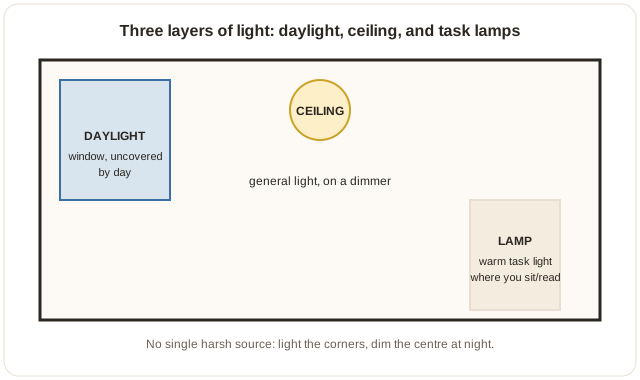
The public rooms of your home — living room, dining room, entryway — are where reputation is practiced in miniature: receiving guests, hosting a meal, showing work, having conversations. Keep these rooms ready for people, not just for yourself: seating for visitors, a clear table, light that flatters faces rather than interrogating them. Warm, layered light — the kind in the diagram above — makes guests look good and feel at ease, and guests who feel at ease remember the visit warmly. The living room guide and the dining room guide cover the arrangements.
The same logic applies to your digital front door if your work is online: a tidy, current public profile, a portfolio that is actually visible, and a workspace background that looks intentional on video calls. Reputation today is formed as often on a screen as at a door, and the same principle — be findable, be presentable, show current work — applies to both.
Confidence and the command position
Confidence has a physical component: people who can see the room feel more in control than people who cannot. Sit in the command position wherever you receive people or do public-facing work — facing the door, back protected — whether that is your desk, your dining chair, or your seat in the living room. The home office guide covers the desk version. This is not vanity; it is the same reason speakers prefer a stage with a view of the audience rather than a stage with their back to the door. Seeing the room lets you relax into it, and relaxed people present better.
Keep your public-facing workspace in good repair, too. A video-call background with a broken shelf, a pile of laundry, or a flickering light tells a professional story you did not intend. You do not need an expensive setup — a plain wall, a plant, a shelf with a few books, and good light from the front are enough. What matters is intention: a background that looks chosen, not accidental.
What not to do
- Do not buy fame objects before the free fixes are done — a bright, welcoming entrance and one wall of real work beat any ornament.
- Do not plaster every wall with old achievements; a selective, current display reads as confidence, a full archive reads as insecurity.
- Do not confuse visibility with noise: a loud, cluttered, over-decorated south is not more "famous" — it is just loud. Bright, warm, and clear beats bright, red, and chaotic.
- Do not hide your work out of modesty and then wonder why nobody knows about it; visibility is a habit, and the home is where the habit starts.
Start this week: light the south, clear the entrance, and put one piece of current work where visitors — and you — will see it daily. None of this guarantees recognition. Recognition comes from work done well and shown honestly, over time. But a home that helps you show up, be seen, and be remembered makes that long work a little easier, every day, in the rooms where you live it.
Go deeper with the book
Feng Shui Made Simple covers every room this way — bedroom, living room, kitchen, office, entryway — with diagrams and a 7-day plan for doing the whole house.
Frequently asked questions
What is the fame sector of the bagua?
The south sector, associated with fame and reputation, whose element is Fire. Its colors are red, orange, and purple, and its shape is triangular or pointed. Keep the south of your home bright, warm, and well-lit.
Can feng shui make me famous?
No arrangement guarantees fame, recognition, or any public outcome. What a home can do is support the behaviors that earn recognition: doing visible work, showing it confidently, welcoming people in, and keeping your public presence in good repair.
Should I display awards and achievements at home?
Yes, selectively. One wall or shelf of current, meaningful recognition — work you are proud of, feedback that mattered — reminds you of your standard and shows visitors what you do. A room plastered in every certificate you have ever received looks backward, not confident.
What if my south sector is dark or windowless?
Add light: warm artificial lighting, a light-colored wall, and a mirror to borrow brightness from a nearby room. The south is the Fire sector, and light is its natural fuel — a well-lit south matters more than any red object.