Door Faces Window: Stop Energy Rushing Through
Open the front door of some houses and you can see straight through to the back garden — door, hallway, and window lined up like a tunnel. It feels airy for about five seconds, and then it feels exposed: the house has no privacy, no pause, and no sense of arrival. Feng shui calls this energy rushing straight through, and the practical version is exactly what you feel — a house that leaks attention, draughts, and warmth straight out the back.
The pattern is common in terraced houses, modern open-plan flats, and any home where the front and back openings were placed for convenience rather than comfort. It is also common in homes that otherwise work well, which is why it is worth fixing rather than accepting: the rush-through affects the entrance, the hallway, and the room at the back all at once.
Why a straight line feels wrong
A straight sightline from the front door to the back window does three practical things. First, it removes privacy: anyone at the front door can see into the back room and the garden, and anyone in the back room feels watched from the street. Second, it creates a wind tunnel — open both ends on a breezy day and the draught races through, slamming doors and chilling the hallway. Third, it removes the sense of arrival: you step in and are already, visually, outside again. A good entrance makes you feel you have arrived somewhere; a tunnel entrance makes you feel you are passing through.
Tradition's version is the same story in symbolic language: energy — and by extension opportunity, money, and attention — enters the front door and leaves by the window without circulating through the house. Whether you read that literally or not, the fix is identical: break the line, so that what comes in has to slow down, turn, and spend time in the house.
The furniture fix: put something in the way
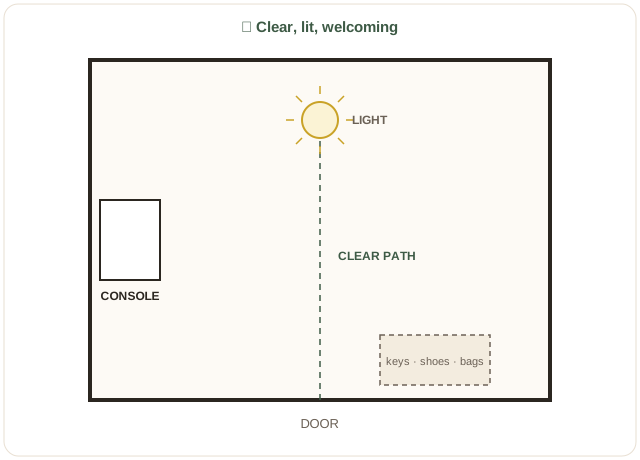
The simplest fix is a piece of furniture placed to interrupt the sightline without blocking the passage. A console table just inside the door, a bookshelf set at right angles to the hallway, or a tall plant where the hallway meets the back room all force the eye to stop and the body to turn slightly. The key is 'slightly': you want a gentle deflection, not an obstacle course. Leave a comfortable walking path — at least 90 centimetres — and put the interrupting piece to one side of it, so the route bends rather than stops.
A screen or a room divider does the same job more strongly, and suits a home where the door opens directly into a living space rather than a hallway. A freestanding screen with a plant beside it creates an entrance zone inside an open-plan room, which is the single most valuable change in a flat with a door-to-window line. The entryway guide covers entrance zones in detail, and the small spaces guide has the flat-sized versions.
Curtains, blinds, and the window end
Work the window end as well as the door end. A sheer curtain or a blind on the back window softens the exit: light still comes in, but the sightline out is filtered, and the tunnel stops reading as a tunnel. If the back window is large, a sheer curtain across the whole window during the day is often enough on its own — the line is broken at the far end, and the house gains privacy in both directions.
At the door end, a solid front door with a fanlight or a glazed panel gives light without a clear view through, which is the best of both. If your front door is fully glazed and lines up with the back window, frosted film on the lower half of the door glass restores privacy without losing daylight. The front door colour guide covers the door itself, including colours that make the entrance feel like a destination rather than a gap.
Rugs, colour, and the floor's story
A rug is the subtlest fix and one of the most effective. A rug in the hallway or entrance zone, in a colour that contrasts with the floor, marks a place to stop — it tells the foot, and the eye, that this is a zone, not a runway. A second rug or a change of flooring in the back room does the same at the far end: the house reads as a sequence of places rather than one long tube. Colour works the same way: a warm accent wall in the entrance zone, or a picture hung where the sightline would otherwise run uninterrupted, gives the eye a destination partway along the line.
Plants are the living version of the same idea. A tall plant at the bend of the route, or a pair of plants flanking the hallway's end, softens the straight line with something alive and irregular. Plants also do honest work here: they filter the draught slightly, they humidify dry hallway air, and they give the entrance something pleasant to look at. The plants guide lists the tolerant species that survive hallway light levels.
Draughts and heat: the unglamorous fix
Do not neglect the physical side. A door-to-window line is a wind tunnel, and wind tunnels cost heat. Draught-proof the front door, check the back window's seals, and fit a draught excluder or a brush strip if the door whistles on windy days. A heavy curtain over the front door in winter — the old-fashioned portière — is unfashionable and extremely effective: it stops the draught, adds insulation, and visually closes the tunnel at the entrance. Sometimes the best feng shui fix is a hardware-store fix.
If the line runs through a room rather than a hallway — door, living room, window, all in one sightline — the furniture arrangement does the work. Angle the sofa or place a bookshelf so the seating group turns away from the line, creating a conversation area that is not on the runway. People sitting with their backs to a straight-through line feel exposed; people sitting in a group angled away from it feel settled. The living room guide covers seating groups that protect their occupants.
A door that faces a window is not a reason to move house. It is a sightline to interrupt, a draught to seal, and an entrance to furnish — three small jobs that turn a tunnel back into a home. Start with the plant or the console table by the door; it takes an afternoon, and you will feel the difference the first time you walk in and the house holds you instead of letting you straight through.
Go deeper with the book
Feng Shui Made Simple covers every room this way — bedroom, living room, kitchen, office, entryway — with diagrams and a 7-day plan for doing the whole house.
Frequently asked questions
Is it bad feng shui if the front door faces a window?
Tradition treats it as energy rushing straight through the house without circulating. In practice the problems are privacy, draughts, and a missing sense of arrival — all fixable by breaking the sightline with furniture, a screen, or a plant.
What is the quickest fix for a door facing a window?
A tall plant, a console table, or a screen placed just inside the door, to one side of the walking path, so the route bends gently instead of running straight. A sheer curtain on the back window helps from the other end.
Does a door facing a window waste heat?
Yes — the straight line acts as a wind tunnel, so draught-proofing the door and the window matters as much as any visual fix. A heavy curtain over the front door in winter is an old, effective answer.
What if the door opens directly into a living room?
Create an entrance zone with a screen or a bookshelf at right angles to the door, and angle the seating group away from the door-to-window line so people sit in a protected group rather than on the runway.
Is a door facing another door the same problem?
It is related but distinct: two doors aligned let energy run straight between rooms. That pattern has its own fixes, covered in the companion guide to two doors aligned.