Chinese Zodiac at a Glance: 12 Signs and Their Elements
The Chinese zodiac is a twelve-year cycle in which each year is named after an animal: Rat, Ox, Tiger, Rabbit, Dragon, Snake, Horse, Goat, Monkey, Rooster, Dog, and Pig. The cycle has run in the same order for well over a thousand years, and it is used across East and Southeast Asia to mark years, to talk about personality in general terms, and to organize festivals, art, and folk custom. This guide explains how the system works, sign by sign. It is general cultural information about a traditional system, not a personal prediction about any individual reader.
Two things are worth knowing before the list. First, your zodiac sign is decided by your birth year in the Chinese lunar calendar, not by the Gregorian January 1 — someone born in January or early February may belong to the previous year's sign, because the lunar new year usually falls in late January or February. Second, each sign carries a fixed element in tradition: Rat Water, Ox Earth, Tiger Wood, Rabbit Wood, Dragon Earth, Snake Fire, Horse Fire, Goat Earth, Monkey Metal, Rooster Metal, Dog Earth, and Pig Water. Those fixed elements are associations used in folk discussion, not measurements of a person.
The twelve signs in order
The order itself has a famous folk tale behind it: the Jade Emperor is said to have held a race, and the animals' finishing order became the cycle's order — Rat first, by cunning, riding on the Ox's back and jumping ahead at the finish. Whether or not you know the tale, the order matters, because the cycle's relationships — which signs sit opposite each other, which form harmonious groups — all come from position in this sequence. The signs, with their traditional elements and the broad traits folk tradition associates with them, are:
- Rat (Water). Quick, resourceful, and sociable in folk descriptions; the first sign of the cycle, associated with new beginnings and clever problem-solving.
- Ox (Earth). Steady, patient, and hardworking; the sign of endurance and of building things slowly and solidly.
- Tiger (Wood). Bold, energetic, and independent; associated with courage and with acting first.
- Rabbit (Wood). Gentle, diplomatic, and cautious; associated with peace-keeping, good taste, and avoiding unnecessary conflict.
- Dragon (Earth). The only mythical animal in the cycle, and the most celebrated in Chinese culture; associated with ambition, charisma, and large-scale energy.
- Snake (Fire). Thoughtful, intuitive, and private; associated with wisdom, reflection, and working behind the scenes.
- Horse (Fire). Warm, active, and freedom-loving; associated with movement, enthusiasm, and independence.
- Goat (Earth). Kind, artistic, and peace-loving; associated with creativity, sympathy, and a preference for harmony over confrontation.
- Monkey (Metal). Clever, playful, and inventive; associated with quick thinking, humor, and finding unusual solutions.
- Rooster (Metal). Observant, precise, and outspoken; associated with attention to detail, punctuality, and saying what others notice but do not say.
- Dog (Earth). Loyal, honest, and protective; associated with fairness, friendship, and standing by people in difficulty.
- Pig (Water). Generous, easygoing, and sincere; associated with contentment, good humor, and enjoying life's pleasures without fuss.
Read those descriptions as folk character sketches, the way you would read a description of a star sign in a newspaper: a cultural shorthand for talking about temperament, not a diagnosis. No tradition that takes itself seriously claims that everyone born in a given year is the same person, and this guide does not either.
How the elements combine with the signs
Each year pairs an animal with one of five elements — Wood, Fire, Earth, Metal, Water — in a repeating sixty-year cycle. That is why there is not just one "Goat year" but five kinds: Wood Goat, Fire Goat, Earth Goat, Metal Goat, and Water Goat, each returning every sixty years. The year 2027, for example, is a Fire Goat year, while the previous Goat year, 2015, was a Wood Goat year. The element is said to color the year's general character in folk discussion — Fire years are described as warmer and more expressive, Water years as more reflective — but again, this is a traditional vocabulary for talking about years, not a forecast of events.
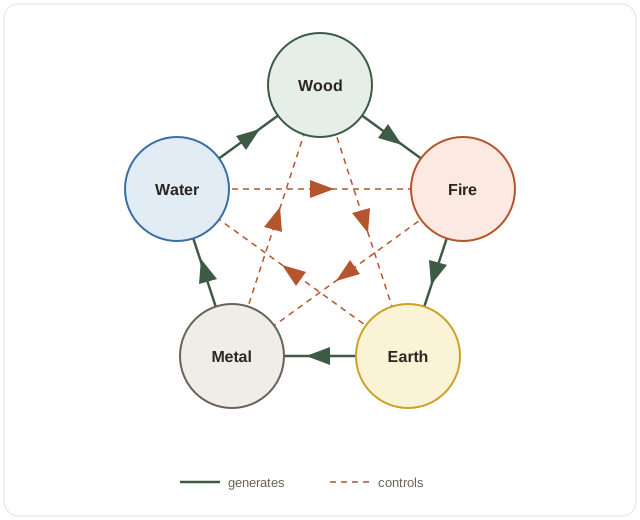
The elements also relate to each other in two cycles that feng shui uses everywhere, including in the home. In the generation cycle, Wood feeds Fire, Fire makes Earth (ash), Earth bears Metal, Metal carries Water (as condensation or as a vessel), and Water nourishes Wood. In the control cycle, Wood controls Earth (roots hold soil), Earth controls Water (banks contain rivers), Water controls Fire, Fire controls Metal (melting), and Metal controls Wood (the axe). If you understand those two cycles, you understand the logic behind much of feng shui's color and material advice: the five elements guide and the colors guide both build on them.
How the signs relate to each other
The cycle's geometry creates the relationships that folk tradition talks about most. Signs six places apart sit opposite each other on the wheel — Rat opposite Horse, Ox opposite Goat, Tiger opposite Monkey, Rabbit opposite Rooster, Dragon opposite Dog, Snake opposite Pig — and opposite pairs are traditionally described as clashing, meaning their approaches differ most sharply. Signs four places apart in groups of three form harmonious trios: Rat, Dragon, and Monkey; Ox, Snake, and Rooster; Tiger, Horse, and Dog; Rabbit, Goat, and Pig. And each sign has one "six harmony" partner, the sign it pairs with most closely: Rat with Ox, Tiger with Pig, Rabbit with Dog, Dragon with Rooster, Snake with Monkey, and Horse with Goat.
These relationships are the machinery behind the annual Tai Sui discussion — which signs tradition lists as clashing with a given year's sign — and the 2027 clash-sign guide and the 2027 zodiac overview explain them for the coming Fire Goat year. The important thing to hold onto is that these are relationships between positions on a wheel, described in general terms by tradition. They describe how a system categorizes years, not what will happen to any particular person in any particular year.
Using the zodiac well
The best use of the zodiac is as a cultural key. It explains why a particular year is celebrated with a particular animal on stamps, decorations, and red envelopes; why certain years are popular for weddings or births in some communities; and why a gift featuring someone's birth-year animal is a thoughtful, personal present. It also gives you a way into Chinese art and literature, where the animals appear constantly as symbols — the Dragon on imperial robes, the Rabbit in moon legends, the Monkey in the great novel Journey to the West.
What the zodiac is not, is a decision-making tool for an individual's life. Choosing a career, a partner, a medical treatment, or an investment on the basis of a birth-year animal would be a misuse of a system that was designed to mark time and organize folk custom, not to predict individual outcomes. Enjoy it as culture, use it to understand celebrations and art, and leave personal decisions to the evidence in front of you. The Earthly Branches guide goes deeper into the twelvefold system underneath the animals, for readers who want to understand how the wheel itself is built.
Go deeper with the book
Feng Shui Made Simple covers every room this way — bedroom, living room, kitchen, office, entryway — with diagrams and a 7-day plan for doing the whole house.
Frequently asked questions
How do I find my Chinese zodiac sign?
By your birth year in the Chinese lunar calendar. If you were born in January or early February, check that year's lunar new year date — you may belong to the previous year's sign, since the lunar year usually starts in late January or February.
What is the difference between a sign and its element?
The sign is the animal of your birth year, and each sign also has a fixed element in tradition — for example, Rat is Water and Tiger is Wood. Separately, each year pairs its animal with a rotating element, giving a sixty-year cycle: 2027 is a Fire Goat year, while 2015 was a Wood Goat year.
Which signs clash with each other?
Signs six places apart on the wheel sit opposite each other and are traditionally described as clashing: Rat-Horse, Ox-Goat, Tiger-Monkey, Rabbit-Rooster, Dragon-Dog, and Snake-Pig. This describes positions on the wheel in general terms, not a prediction about any two people.
What are the harmonious sign groups?
Groups of three, four places apart: Rat-Dragon-Monkey, Ox-Snake-Rooster, Tiger-Horse-Dog, and Rabbit-Goat-Pig. Each sign also has one six-harmony partner: Rat-Ox, Tiger-Pig, Rabbit-Dog, Dragon-Rooster, Snake-Monkey, and Horse-Goat.
Can the zodiac predict my future?
No. This guide treats the zodiac as general cultural information about a traditional system. It describes how years are categorized and talked about in folk tradition; it does not predict any individual's fortune, health, wealth, or relationships.