2027 Zodiac Overview: The Fire Goat Year
The year 2027 is the year of the Goat — more precisely, the Fire Goat year, known in the traditional stem-branch system as Ding Wei (丁未). In the lunar calendar it runs from Chinese New Year Day, Saturday 6 February 2027, to 25 January 2028, while in the solar-term system used by feng shui and Chinese astrology it runs from Lichun (the start of spring) on 4 February 2027 to 3 February 2028. This guide explains what those labels mean, how the year's chart is arranged, and what tradition says about the year in general terms. It is general cultural information about a traditional system, not a personal prediction about any individual reader.
The stem-branch system pairs ten heavenly stems with twelve earthly branches to make a sixty-year cycle. In 2027 the stem is Ding, associated with Yin Fire, and the branch is Wei, the Goat, whose fixed element in tradition is Earth. Fire and Earth sit next to each other in the generation cycle — Wood feeds Fire, and Fire makes Earth — so a Fire Goat year is traditionally described in general terms as a warm, consolidating year: a year for finishing, furnishing, and giving solid form to things begun in the faster, more expansive Fire Horse year of 2026. That is a description of a year's folk character, not a promise about what any household will experience.
The year's chart at a glance
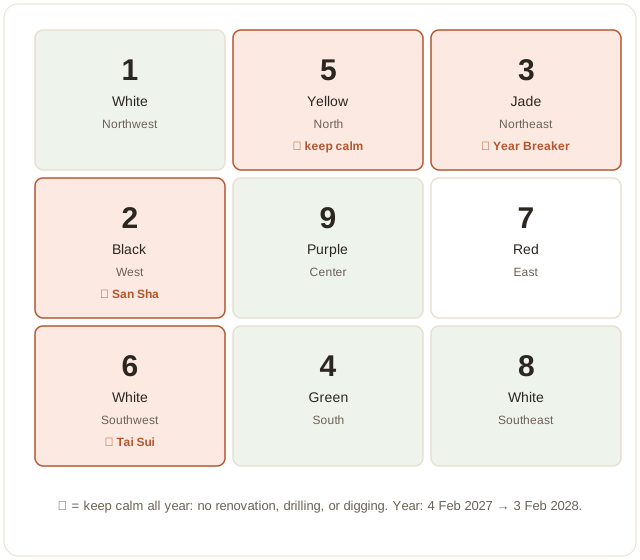
Feng shui's annual flying stars map the year's energies onto the nine sectors of a home. For 2027 the chart is: center 9 Purple, Southeast 8 White, Northwest 1 White, Southwest 6 White with Tai Sui, South 4 Green, North 5 Yellow, West 2 Black with San Sha, Northeast 3 Jade with the Year Breaker, and East 7 Red. The full sector-by-sector guide is in the Flying Stars 2027 article, and the sector articles explain each position in detail — for example, the Five Yellow in the North and Tai Sui in the Southwest.
Two features of the chart shape the year's practical advice. First, the center holds the 9 Purple star, the star of the current Period 9, so the center of the home is traditionally treated as the year's brightest sector — kept open, well lit, and uncluttered. Second, the difficult stars cluster in the North (5 Yellow), West (2 Black with San Sha), and Northeast (3 Jade with the Year Breaker), while Tai Sui sits in the Southwest. The customary advice for those sectors is consistent across the site's 2027 articles: keep them calm, quiet, and undisturbed, and postpone major renovation there where possible. The site's 2027 do's and don'ts guide collects that advice in one place.
The Goat in tradition
The Goat is the eighth sign of the cycle, and folk tradition describes it as kind, artistic, peace-loving, and fond of harmony — a sign associated with creativity, sympathy, and a dislike of confrontation. Goat years are accordingly talked about in general terms as gentler, more domestic years than the bold years around them: years when home, craft, food, and close relationships get more attention than conquest or competition. The Goat's harmonious partners in tradition are the Horse (its six-harmony pair) and the Rabbit and Pig (its three-harmony trio), while the Ox sits directly opposite it on the wheel. Those relationships are the background to the annual Tai Sui discussion, covered in the Tai Sui clash signs for 2027 guide.
The Goat's fixed element is Earth, and Earth years and signs are traditionally linked with the center and the Southwest and Northeast sectors of the bagua — the Southwest for love and relationships, the Northeast for knowledge and study, the center for overall wellbeing. Those are the traditional sector associations, useful for understanding why certain rooms get attention in a Goat year; they are not instructions to redecorate a whole house around one animal. The bagua map guide explains the full sector layout for readers who want the complete picture.
Dates that matter, and the two new years
One point confuses many people, and it is worth stating plainly: 2027 has two defensible "new year" dates, two days apart. Chinese New Year Day — the festival, the reunion dinner the night before, the red envelopes — falls on Saturday 6 February 2027, and on that reckoning the Goat year runs to 25 January 2028. Lichun, the solar term marking the start of spring, falls on 4 February 2027, and that is the date Chinese astrology and feng shui use for the year pillar. Someone born on 5 February 2027 is therefore a Goat in the astrological reckoning but was born before the festival new year — one of those small gaps that makes January and February birthdays worth checking carefully, as the zodiac guide notes.
For household purposes, the practical calendar is simpler: prepare the home in late January, before either date, so the house is clean, repaired, and welcoming whichever reckoning you follow. The Chinese New Year 2027 preparation checklist lays that out week by week, and the before-Lichun checklist covers the feng shui-specific preparations. Between the two, a household can enter the Goat year with the house in order and nothing left to guesswork.
How to use a year overview
A year overview is most useful as orientation, not as a set of orders. Read the chart, note which sectors of your own home hold the year's afflictions, and plan any renovation around them where you can. Notice which rooms the year's bright sectors fall in, and spend a little more time making those rooms pleasant — light, air, and a clear floor do more than any purchased cure. And treat the year's folk character as atmosphere, not destiny: a "gentle" year still contains difficult weeks, and a difficult sector still contains pleasant rooms, because a home is lived in room by room, not year by year.
If you take one thing from this overview, take the dates and the chart. The Goat year, Ding Wei, Fire over Earth, runs from Lichun on 4 February 2027 (festival new year 6 February) through 3 February 2028, with 9 Purple in the center and Tai Sui in the Southwest. Everything else in the 2027 guides is commentary on that frame — useful commentary, but commentary. The frame itself is what lets you place every other piece of 2027 advice in your own home, in your own rooms, on your own calendar.
Go deeper with the book
Feng Shui Made Simple covers every room this way — bedroom, living room, kitchen, office, entryway — with diagrams and a 7-day plan for doing the whole house.
Frequently asked questions
When does the Fire Goat year start?
It depends on the reckoning: Lichun, the solar-term date used by feng shui and astrology, falls on 4 February 2027, while Chinese New Year Day, the festival date, falls on Saturday 6 February 2027. The lunar year runs to 25 January 2028, and the feng shui year to 3 February 2028.
What does Ding Wei mean?
Ding is the year's heavenly stem, associated with Yin Fire, and Wei is the year's earthly branch, the Goat. Together they make Ding Wei, one of the sixty stem-branch combinations, returning every sixty years.
What is the 2027 flying stars chart?
Center 9 Purple, Southeast 8 White, Northwest 1 White, Southwest 6 White with Tai Sui, South 4 Green, North 5 Yellow, West 2 Black with San Sha, Northeast 3 Jade with the Year Breaker, and East 7 Red.
Which sectors need the most care in 2027?
Tradition advises keeping the North (5 Yellow), West (2 Black with San Sha), Northeast (3 Jade with the Year Breaker), and Southwest (Tai Sui) calm and undisturbed, and postponing major renovation there where possible.
Is this overview a prediction about me?
No. It is general cultural information about how tradition describes the year 2027. It does not predict any individual's fortune, health, wealth, or relationships.