The 12 Earthly Branches: How the Zodiac Cycle Works
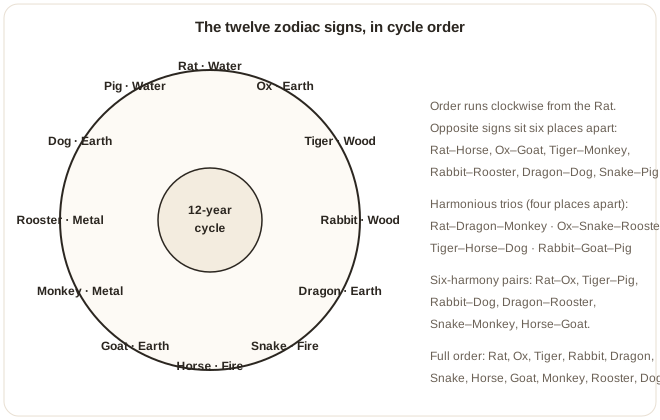
Beneath the twelve zodiac animals lies an older system: the twelve Earthly Branches (地支, dìzhī). Each animal is the popular face of one branch — Rat is Zi (子), Ox is Chou (丑), Tiger is Yin (寅), Rabbit is Mao (卯), Dragon is Chen (辰), Snake is Si (巳), Horse is Wu (午), Goat is Wei (未), Monkey is Shen (申), Rooster is You (酉), Dog is Xu (戌), and Pig is Hai (亥). The branches are a counting and categorizing system that marks years, months, days, hours, and directions, and understanding them explains why the zodiac works the way it does. This guide explains the system in general terms, as cultural information about a traditional framework — not as a personal prediction about any reader. In short, this article is general cultural information about a traditional system, not a personal prediction.
The branches are one half of a pair. Chinese tradition counts time with two interleaved cycles: the ten Heavenly Stems (天干, tiāngān) and the twelve Earthly Branches. The stems are associated with the five elements in yin and yang pairs — Jia and Yi are Wood, Bing and Ding are Fire, Wu and Ji are Earth, Geng and Xin are Metal, Ren and Gui are Water — and the branches carry the animals. Pairing a stem with a branch, stepping through both cycles together, produces the sixty-year cycle: because ten and twelve share only the factor two, the pairings run through sixty unique combinations before repeating. That is why 2027 is Ding Wei — the Ding stem with the Wei branch — and why the next Ding Wei year will be 2087, sixty years later.
The branches also carry their own fixed elements and yin-yang polarities, which differ slightly from the animals' popular associations and are worth stating carefully. In the traditional branch system, Zi (Rat) is Yang Water, Chou (Ox) is Yin Earth, Yin (Tiger) is Yang Wood, Mao (Rabbit) is Yin Wood, Chen (Dragon) is Yang Earth, Si (Snake) is Yin Fire, Wu (Horse) is Yang Fire, Wei (Goat) is Yin Earth, Shen (Monkey) is Yang Metal, You (Rooster) is Yin Metal, Xu (Dog) is Yang Earth, and Hai (Pig) is Yin Water. Notice that the branch elements match the animals' fixed elements given in the zodiac guide — Rat Water, Ox Earth, and so on — because the animal and the branch are two faces of the same position. The yin-yang polarity is the extra layer the branches add: the cycle alternates yin and yang at every step, which is why stems and branches pair only in matching polarities, and why the cycle takes sixty years rather than thirty.
Branches as directions
Each branch occupies a direction on the compass, dividing the full circle into twelve equal parts of thirty degrees each. Zi (Rat) sits due North, Wu (Horse) due South, Mao (Rabbit) due East, and You (Rooster) due West, with the other eight branches filling the spaces between: Chou and Yin in the Northeast, Chen and Si in the Southeast, Wei and Shen in the Southwest, Xu and Hai in the Northwest. This is the branch compass used in classical feng shui, and it is finer than the eight-sector bagua — a branch compass has twelve directions where the bagua has eight, so a branch reading can place a door or a sector more precisely than a bagua sector alone.
That precision is why branch directions matter in annual feng shui. Tai Sui in 2027 occupies the Southwest because Wei, the Goat's branch, sits in the Southwest; the Year Breaker sits opposite, in the Northeast, because Chou, the Ox's branch, sits there. The 2027 clash-sign guide and the compass reading guide both use this logic. For most households, the practical takeaway is simpler: when a traditional source names a branch direction, it is naming a thirty-degree slice of the compass, and a compass reading from the center of the home will show which room that slice falls in.
Branches as time: months, days, and hours
The branches do not only mark years. They mark months: each lunar month carries a branch, with Yin (Tiger) traditionally opening the year at Lichun, the start of spring. They mark days: a sixty-day cycle runs through the stem-branch pairs continuously, so any date in history can be expressed as a stem-branch day. And they mark hours: the traditional Chinese day divides into twelve double-hours, each named after a branch, with Zi covering 11pm to 1am, Chou 1am to 3am, Yin 3am to 5am, Mao 5am to 7am, Chen 7am to 9am, Si 9am to 11am, Wu 11am to 1pm, Wei 1pm to 3pm, Shen 3pm to 5pm, You 5pm to 7pm, Xu 7pm to 9pm, and Hai 9pm to 11pm.
That double-hour system is still alive in everyday language: the Chinese word for "noon" relates to Wu, and the traditional term for midnight relates to Zi. It also explains a piece of folk custom: a child born at, say, the Mao hour (5am to 7am) is said in tradition to carry the Rabbit branch in their hour pillar, one of the four pillars — year, month, day, hour — that make up a traditional birth chart. The four-pillars system (BaZi, 八字, literally "eight characters") uses the stem-branch pairs of all four pillars to describe a person's chart in general terms. This guide does not calculate or interpret any individual's chart; it describes the framework so readers can understand what traditional sources mean when they refer to pillars, branches, and hours.
How the branches relate to each other
The relationships between branches are the machinery behind much of traditional Chinese astrology, and they are worth understanding as geometry rather than mystery. Six pairs clash, because they sit opposite each other on the wheel: Zi–Wu, Chou–Wei, Yin–Shen, Mao–You, Chen–Xu, and Si–Hai. Six pairs harmonize, because they combine in the traditional six-harmony system: Zi–Chou, Yin–Hai, Mao–Xu, Chen–You, Si–Shen, and Wu–Wei. Four trios form the three-harmony groups: Shen–Zi–Chen, Hai–Mao–Wei, Yin–Wu–Xu, and Si–You–Chou. And smaller groups form harm, punishment, and break relationships — the same categories that produce the annual Tai Sui lists.
Notice that every one of these relationships is a statement about positions on a wheel, and that the same relationships reappear at every scale: a year branch, a month branch, a day branch, and an hour branch can all clash or harmonize with each other in the traditional system. That is why traditional astrology is so detailed — it is not one wheel but four, turning together — and also why it is so easy to over-read: with four wheels and dozens of named relationships, almost any chart contains both harmonious and clashing pairs. A responsible reading of the system, and the one this site follows, treats those relationships as a traditional vocabulary for describing time, not as verdicts on a person's life.
Why the branches still matter
The branches survive because they are useful, not merely because they are old. They give Chinese culture a compact way to name years — "the Ding Wei year" is shorter and more precise than "the Fire Goat year," and it places the year exactly in the sixty-year cycle. They give the calendar a rhythm that farmers, festival organizers, and almanac readers have used for centuries. And they give feng shui its directional language: when a practitioner says a house 'sits' in a particular branch direction, they are using the branch compass to say something precise about the house's orientation, which can then be checked with a compass.
For the general reader, the branches are best understood as the engine room of the zodiac: the animals are the friendly face, the branches are the mechanism underneath, and the sixty-year stem-branch cycle is the clock the whole system runs on. Learn the order — Zi, Chou, Yin, Mao, Chen, Si, Wu, Wei, Shen, You, Xu, Hai — and the rest of the tradition's time language starts to make sense: why Goat years and Ox years clash, why the year's guardian sits where it sits, and why a year has both a festival new year and an astrological new year. The 2027 overview shows the whole system applied to a single year, and it is a good place to see the branches at work.
Go deeper with the book
Feng Shui Made Simple covers every room this way — bedroom, living room, kitchen, office, entryway — with diagrams and a 7-day plan for doing the whole house.
Frequently asked questions
What is the order of the twelve Earthly Branches?
Zi Rat, Chou Ox, Yin Tiger, Mao Rabbit, Chen Dragon, Si Snake, Wu Horse, Wei Goat, Shen Monkey, You Rooster, Xu Dog, Hai Pig. The same order as the zodiac animals, because each animal is the popular face of one branch.
Why does the stem-branch cycle take sixty years?
Ten heavenly stems and twelve earthly branches step together, pairing only in matching yin-yang polarities. Because ten and twelve share only the factor two, the pairings run through sixty unique combinations before repeating — so 2027's Ding Wei returns in 2087.
What are the traditional double-hours?
Zi 11pm–1am, Chou 1–3am, Yin 3–5am, Mao 5–7am, Chen 7–9am, Si 9–11am, Wu 11am–1pm, Wei 1–3pm, Shen 3–5pm, You 5–7pm, Xu 7–9pm, Hai 9–11pm.
How do branch relationships work?
They are positions on a wheel: opposite branches clash (Zi–Wu, Chou–Wei, Yin–Shen, Mao–You, Chen–Xu, Si–Hai), six pairs harmonize (Zi–Chou, Yin–Hai, Mao–Xu, Chen–You, Si–Shen, Wu–Wei), and four trios form three-harmony groups (Shen–Zi–Chen, Hai–Mao–Wei, Yin–Wu–Xu, Si–You–Chou).
Does this system predict anything about me?
No. The Earthly Branches are a traditional framework for marking time and direction. This guide describes that framework in general terms; it does not calculate or interpret any individual's chart and does not predict personal outcomes.