Candles and Firelight: Safe Ways to Add Fire
Fire is the most powerful element in feng shui, and the one that demands the most respect. A flame is alive in a way no other household object is: it moves, it warms, it draws the eye, and it can burn the house down. That is why candles sit at the center of this guide — not as decoration, but as the most direct way to bring the fire element into a room, and the one that requires the clearest safety rules.
In the five elements, Fire is generated by Wood and generates Earth: Wood feeds a flame, and a flame leaves ash, which is Earth. Fire's colors are red and orange, its direction is the South, and its traditional association is fame, visibility, and warmth. When a room feels cold, flat, or lifeless, a little fire — real or electric — is often the fastest fix. The trick is adding it deliberately, in the right places, and never at the expense of safety.
This guide covers what firelight actually does to a room, where candles belong, where they do not, and the safer alternatives that give you the same effect without the flame.
What firelight does to a room
Firelight changes a room in a way no ceiling light can. A flame flickers, and flicker is movement — the eye is drawn to it the way it is drawn to water or wind. That is why a single candle on a dining table transforms a meal: it creates a small circle of attention, pulls everyone's gaze inward, and slows the room down. Overhead lighting does the opposite, flattening everything into even brightness and hurrying people along.
Warm light also changes how people look and feel. Candlelight is warm in color temperature, which flatters skin, softens hard edges, and makes a room feel smaller and more intimate. This is not mysticism; it is the same reason restaurants use dim, warm lighting and hospitals use bright, cool lighting. One says "stay and linger," the other says "this is a place for work." Your home should mostly say the first.
Fire also gathers people. A fireplace, a candlelit table, a lantern on a balcony — all of them create a natural center that people arrange themselves around, the way the living room guide describes seating gathering around a focal point. If a room feels scattered, with no obvious place to sit or look, a single flame can quietly solve that problem.
Safety first, always
Every feng shui benefit of candles disappears the moment one becomes a hazard, so the safety rules come before the placement rules. Never leave a burning candle unattended — not for a quick errand, not while you fall asleep, not "just for a minute." Never place a candle near curtains, bedding, bookshelves, or anything that can catch. Keep candles on stable, heat-proof surfaces, away from drafts that can push a flame sideways into something flammable.
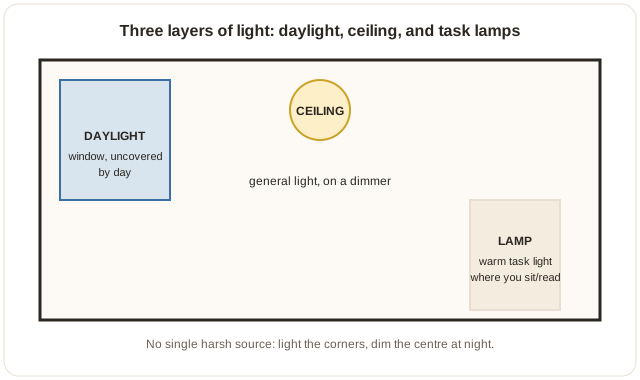
Keep candles out of reach of children and pets, and out of rooms where they might be knocked over — hallways people hurry through, for example, or a bathroom shelf beside a wet floor. Trim wicks to about half a centimeter before lighting, so the flame stays small and steady instead of tall and smoky. And when in doubt, blow it out. A room does not need a flame to be warm; the light guide shows how layered lamps achieve the same warmth with none of the risk.
This is not caution for caution's sake. Good feng shui is about a home that supports the people in it, and a home that burns is the opposite of support. Any tradition that asks you to risk safety for symbolism has been misunderstood. Safety is part of the practice, not an exception to it.
Where candles belong
The dining table is the best place for a candle in most homes. One candle, or a pair, in the center of the table, lit for a meal, does everything firelight is supposed to do: it marks the meal as an occasion, gathers attention, and makes the food look good. Keep the flame below eye level so people can see each other across it — a tall candlestick that blocks faces defeats the purpose. The dining room guide covers table setup in full.
The living room mantelpiece or coffee table is the second good spot, especially in the evening when the ceiling lights go off and the room shifts from daytime activity to rest. A candle here, lit for an hour or two while you read or talk, signals the day winding down. The bathroom is a common candle spot in magazines, but it is a poor one in practice: water dominates the bathroom, a wet surface is a bad base for a flame, and a candle beside a bath you might doze in is a risk, not a ritual.
The South sector of a home — traditionally fame and Fire's direction — is where tradition places red candles, and if you have a south-facing living area or study, a candle there is a natural fit. But direction is a gentle nudge, not a requirement: a candle that is safe, visible, and actually lit beats a candle placed "correctly" in a south corner that nobody ever lights.
Where fire does not belong
Bedrooms deserve special caution. A candle in a bedroom you might fall asleep in is a risk that no amount of atmosphere justifies. If you want candlelight in a bedroom, use a flickering LED candle: you get the warm, moving light with zero flame, and you can fall asleep without worrying. The same applies to children's rooms and to any room where someone might doze off — a nursery, a sickroom, a reading nook with a comfortable chair.
Kitchens already have fire — the stove — and adding open flames to a room full of cooking oil, tea towels, and busy hands is unnecessary. If the kitchen feels cold or flat, warm lighting and the kitchen guide's color suggestions will do more than a candle on the counter. Garages, laundry rooms, and storage areas are also wrong for candles: these are utility spaces, and an open flame among paint cans, cleaning products, or stacked boxes is a hazard, not an enhancement.
Finally, do not use candles to "fix" a problem room. A dark, damp, or cluttered corner does not need a candle; it needs light, air, and clearing. Firelight layered over clutter just makes the clutter prettier. Fix the room first, then add the flame as a finishing touch.
Color, number, and the electric alternative
Candle color follows the element colors: red, orange, and pink carry Fire most directly, and tradition links red candles with the South. White and cream candles are neutral and suit any room, and their light is identical — the flame, not the wax, does the work. Choose the color that looks good in your room rather than agonizing over a chart. The colors guide covers the full palette if you want to go deeper.
Number matters more than color. One or two lit candles change a room's mood completely; a dozen turn it into a display, and a shelf full of unlit candles is just clutter wearing a costume. Feng shui favors deliberate placement over quantity. Buy fewer candles, in holders you like, and actually light them — a candle that sits unlit for a year is not bringing fire into your home, it is bringing dust.
For many homes, flickering LED candles are simply the better choice, and they are fully acceptable in feng shui. They give the warm, moving light that makes a room feel alive, they can go in bedrooms and children's rooms, and they can stay on all evening without a second thought. A purist might insist on real flame, but a practice that serves real households accepts the safer tool. The same logic applies to fireplaces: a real fire is wonderful when it is safe and tended; an electric fire or even a good lamp gives most of the warmth with none of the work.
Starting tonight
Pick one room — the dining room or living room — and one candle you already own. Clear a stable, heat-proof spot for it, trim the wick, and light it for one evening meal or one hour of reading, with the ceiling lights off or dimmed. Notice what changes: the room feels smaller, warmer, and more focused, and people linger a little longer. Then blow it out before bed, and put the candle somewhere you will actually reach for it again. A candle used weekly beats a candle collection admired yearly, and a home that gathers around a little fire, safely, is a home doing feng shui right.
Go deeper with the book
Feng Shui Made Simple covers every room this way — bedroom, living room, kitchen, office, entryway — with diagrams and a 7-day plan for doing the whole house.
Frequently asked questions
Are candles good feng shui?
Yes, when they are used safely and deliberately. Candles bring the fire element — warmth, light, and gathering — into a room. But an unattended candle, or a candle crammed against curtains, is a fire hazard first and a feng shui object second. Safety is part of good feng shui, not separate from it.
Where should I not put candles?
Never near curtains, bedding, bookshelves, or anything flammable; never in a bedroom you might fall asleep in; never in a room with pets or small children unsupervised. Also avoid the bathroom, where water dominates and a candle is both pointless and risky on a wet surface.
Do candle colors matter in feng shui?
Red, orange, and pink candles carry the fire element most directly, and tradition links red candles with the south, the fame sector. But color is a gentle association, not a rule: a white or cream candle in a safe holder gives you the same warm light, and the light matters more than the wax color.
Are electric or LED candles acceptable in feng shui?
Yes, and for many homes they are the better choice. A flickering LED candle gives the warm, moving light that makes a room feel alive, with no flame risk. They are ideal for bedrooms, homes with pets or children, and anywhere you want candlelight without watching a flame.
How many candles should I light at once?
Fewer than you think. One or two candles in a room change its mood completely; a dozen turn it into a display. Feng shui favors deliberate placement over quantity: a single candle on the dining table or mantelpiece, lit for a meal or an evening, does more than a shelf full of unlit candles.