Staircase Types: Straight, L-Shaped, and Spiral
A staircase is the busiest piece of architecture in a two-storey home. Everyone uses it, several times a day, and it decides how the upstairs and downstairs feel connected — or divided. In feng shui, a staircase is also a channel: it carries movement, light, sound, and attention from one floor to the other, and its shape decides whether that flow feels steady, rushed, or cramped.
Most feng shui advice about stairs focuses on one problem: a staircase facing the front door. That problem has its own guide — see the staircase facing the door article — and this one is different. Here the question is shape. A straight flight, an L-shaped flight, and a spiral each behave differently, and each has its own strengths to keep and weak points to soften. None of them is "bad" in itself. The right question is always: what does this shape do to the people who climb it every day?
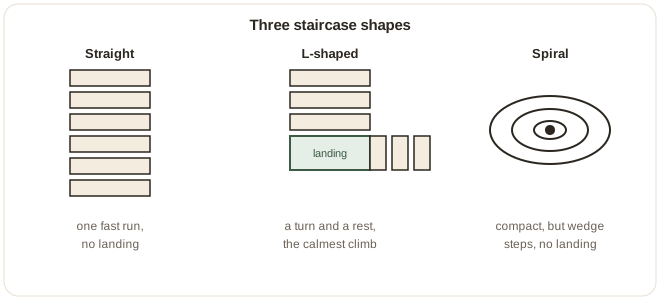
Straight staircases: fast, clear, and hard to slow down
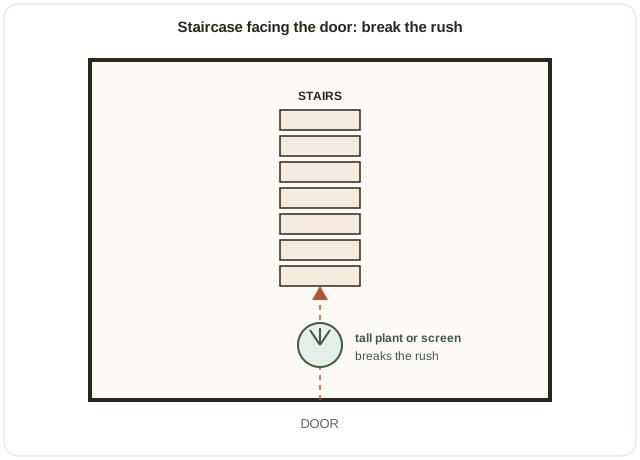
A straight staircase runs in one unbroken flight from floor to floor. It is the simplest to build, the easiest to carry furniture up, and the clearest to navigate in the dark — all real advantages. Its feng shui weakness is speed. With no turn and no landing, movement rushes straight up or straight down, and the eye follows the same line. In a home where the stairs face the front door, that rush is exactly the problem: energy arrives and shoots upstairs without pausing in the ground-floor rooms.
The fix for a straight flight is to break the line without blocking the stair. A landing rug or a runner in a warm, grounding color slows the eye. A tall plant, a console table, or a screen at the foot of the stairs gives arriving energy something to meet before the climb, the same principle used in the entryway guide. On the stair itself, closed risers feel calmer than open ones: open risers let light and sightlines leak through the steps, which can make the climb feel exposed, especially for children and older adults. If your straight stair is open-riser, a runner and solid handrails on both sides go a long way toward making it feel secure.
L-shaped staircases: the turn that calms everything
An L-shaped staircase turns 90 degrees halfway up, usually at a square landing. That landing is the whole point. It breaks the climb into two shorter flights, gives people a place to pause, turn, and change direction, and it breaks the rush that a straight flight cannot. For that reason, the L-shape is the shape most feng shui practitioners prefer: it moves people steadily rather than hurriedly, and it is safer, because a fall is interrupted by the landing instead of continuing to the bottom.
The landing itself deserves attention, because it is the one part of the stair people actually linger on. Keep it clear — no boxes, no laundry baskets, no overflow storage. A landing used as a cupboard tells everyone who climbs past it that the house has run out of room, and it narrows the turn at exactly the point where people need space to pivot. Give the landing light of its own: a small wall light or a window at the turn makes the whole stair feel welcoming rather than tunnel-like, and it helps with the practical problem of seeing the step edge at night. A picture or a small plant on the landing wall is fine; a piece of furniture that juts into the walking line is not.
One detail to check on an L-shaped stair is what sits under the turn. The space beneath a landing is often boxed in as a cupboard, which is fine, but it should not become a dark, damp corner that nobody opens. If the under-stair cupboard is on your entry route, keep it tidy and dry, because a neglected void under the stairs drags down the feeling of the whole hall.
Spiral staircases: beautiful, compact, and demanding
A spiral staircase winds around a central pole, and it earns its place by saving space: it can connect two floors in a footprint barely wider than a doorway. In small homes, converted lofts, and garden studios, that compactness is often the reason the upstairs is usable at all. But the spiral asks more of its users than any other shape. The steps narrow toward the center, so every step is a wedge; the climb is continuous with no landing to rest on; and carrying anything large — furniture, a laundry basket, a sleeping child — is awkward at best.
Feng shui's traditional objection to spiral stairs is that the winding motion stirs energy into a vortex instead of letting it settle, and that a spiral in the center of a home is especially unsettled, because the center is the home's balancing point. You do not need to believe in vortices to see the practical version of the same point: a spiral in the middle of a plan dominates the rooms around it, cuts them into awkward wedges, and becomes a noisy, echoing column that carries sound between floors. If you have the choice, put a spiral stair against an outside wall or in a corner, where its curve hugs the edge of the plan instead of carving up the middle.
If a spiral is what you already have, soften it rather than fighting it. A solid handrail on the outer edge — not just the central pole — makes the climb feel far safer, because people naturally grip the outer side. Warm, even lighting along the whole climb matters more here than on any other stair, since wedge steps are easy to misjudge in shadow. And keep the center pole clear: hanging bags, coats, or cables from it turns a sculptural feature into a cluttered one. The hallway guide has more on keeping the routes between rooms clear and well lit.
What all three shapes share
Whatever the shape, four rules apply to every staircase. First, keep it clear: stairs are a route, not a shelf, and anything stored on a step is both a trip hazard and a daily reminder of clutter. Second, light it well, top and bottom, so nobody climbs into darkness — a stairwell lit only from the top is a stairwell with a shadowed first step. Third, fix creaks, loose rails, and worn treads promptly; a staircase you do not trust is a staircase you hurry down, and hurrying is how falls happen. Fourth, watch what the stair faces at the bottom. A stair that lands facing a bathroom door, a kitchen stove, or a blank wall feels abrupt; a stair that lands facing a window, a picture, or an open room feels like an arrival. If you cannot change what it faces, a runner, a plant, or a piece of art at the foot can redirect the eye.
Finally, remember that a staircase is also a sound channel. Hard surfaces echo, and a stairwell can carry a television's noise upstairs or a bedroom conversation down. Runners, carpeted treads, and a soft furnishing or two in the hall at the foot of the stairs absorb a surprising amount of that sound. A quiet stair is a calmer house, whatever its shape — and a calmer house is the whole point of the exercise.
Go deeper with the book
Feng Shui Made Simple covers every room this way — bedroom, living room, kitchen, office, entryway — with diagrams and a 7-day plan for doing the whole house.
Frequently asked questions
Which staircase shape is best for feng shui?
The L-shape is usually preferred, because its landing breaks the climb into two shorter flights and slows movement naturally. A straight flight is fine if its foot is softened with a plant, screen, or console, and a spiral works best tucked against a wall rather than in the center of the home.
Is a spiral staircase bad feng shui?
Not automatically. The traditional concern is that a spiral stirs energy instead of settling it, especially in the center of a home. Practically, wedge-shaped steps and the lack of a landing make spirals harder to use safely, so a solid outer handrail and even lighting matter more than on other stairs.
What should I do about a staircase facing the front door?
That is a separate problem from shape, and it has its own guide: break the straight rush with a tall plant, screen, or console at the foot of the stairs, and use a runner to slow the eye. Distance helps too — the farther the door is from the first step, the smaller the problem.
Can I fix a bad staircase without rebuilding it?
Almost always. Runners, lighting, handrails, plants, and clearing clutter from the steps and landing change how a staircase feels far more than its shape does. Rebuilding is rarely needed; softening and maintaining usually is.
What should never be stored on or under the stairs?
Nothing should live on the steps themselves — that is a trip hazard. Under the stairs, a tidy, dry cupboard is fine, but a dark, damp, overflowing void drags down the whole hall. Keep it clean, dry, and closed.