Low Ceilings: 7 Ways to Lift the Pressure
You know a low-ceilinged room the moment you walk into it: the air feels closer, the room feels smaller than its floor area, and tall visitors duck slightly even when they do not need to. Feng shui calls this pressing energy — weight from above — and the practical version is the same feeling: a ceiling that sits too close to your head makes a room feel like it is leaning on you. The good news is that most of the fix is not structural. It is light, colour, and furniture, and it works in rented rooms too.
First, a reality check. A ceiling under about 2.4 metres (eight feet) starts to feel low to most people, and anything under 2.2 metres feels low to almost everyone. But the feeling depends on more than the measurement: a low ceiling in a bright room with tall windows feels fine, while the same height in a dark, cluttered room feels oppressive. That is why the fixes below work — they change the room's brightness, openness, and proportions, which is what your eye actually reads as 'low' or 'high'.
1. Light the ceiling, not just the room
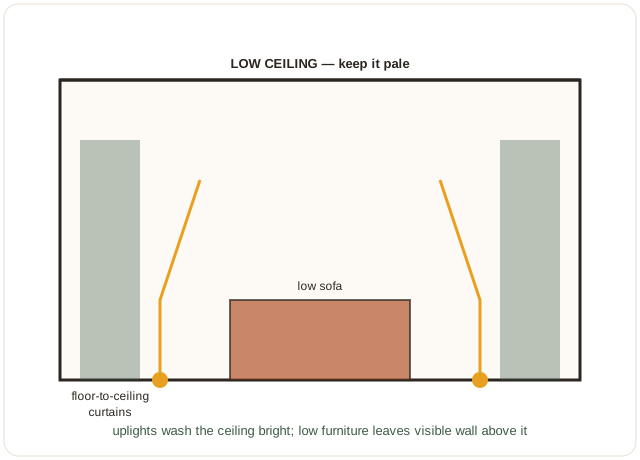
The fastest single change is uplighting. A floor lamp that washes light up the wall and across the ceiling makes the ceiling a bright surface instead of a dark lid, and a bright surface reads as farther away. Wall washers, a lamp bounced off a white ceiling, or LED strips hidden on top of a wardrobe all do this. Avoid the opposite: a single pendant hanging low in the middle of the room, which puts a bright object at head height and makes the ceiling feel lower still. If you have a pendant, raise it as high as it will go, or replace it with a flush ceiling light.
2. Paint the ceiling white — and the walls lighter than you think
White or very pale ceilings are not a cliché, they are optics: a pale ceiling reflects light and visually recedes. If the walls are dark, the ceiling feels lower by contrast, so the classic combination is pale ceiling, mid-tone walls, and a darker floor — the room reads as grounded at the bottom and open at the top. A single strong colour on one wall is fine, but painting the ceiling itself a colour, or running a dark wall colour up onto the ceiling, is the quickest way to make a low room feel lower.
3. Go low with the furniture
Proportion is the quiet trick. In a low room, low furniture — a low sofa, a low bed frame, low shelving — leaves more visible wall above it, and that visible wall is what your eye measures as height. A tall bookcase that nearly touches the ceiling does the opposite: it draws the eye up to the point where the furniture meets the ceiling and announces how little space is left. If you need tall storage, put it against one wall only, and keep the rest of the room's furniture low. The bedroom guide has the low-bed version of this for the room where ceiling pressure is felt most.
4. Use vertical lines
Vertical stripes, tall narrow pictures hung in a vertical row, floor-to-ceiling curtains, and tall narrow plants all pull the eye upward and make the wall read as taller than it is. Curtains deserve a special mention: hang them from as close to the ceiling as possible and let them fall to the floor, even if the window itself is small. The curtain becomes a tall rectangle that redefines the wall's proportions. The same trick works with a tall mirror — it doubles the visible height, which is why the mirror guide's placement rules matter: a tall mirror on a side wall, not facing the bed or the door.
5. Clear the top of everything
Clutter on top of wardrobes, shelves, and cabinets is the low ceiling's worst friend. Every object stored up high draws the eye to the ceiling line and reminds you how close it is. Clear the tops completely, or keep one intentional object — a plant trailing down, a single vase — and nothing else. The same goes for hanging things: mobiles, hanging planters, and low-hanging light fittings all occupy the air between your head and the ceiling, and in a low room that air is precious. Keep it empty.
6. Choose the right light fittings and beams
If the room has beams, they need the same treatment as any other ceiling feature: paint them the same colour as the ceiling so they blend in, rather than a dark contrasting stain that turns each beam into a bar across the room. Beams over a bed are the classic case — the beams guide covers that specifically — but beams anywhere in a low room press down visually, and painting them out is the cheapest structural-looking fix available. Recessed or flush lights beat pendants for the same reason: nothing hanging down means nothing to duck under, even mentally.
7. Borrow height from the next room
The last fix is about the room beyond. A low room that opens onto a brighter, taller space feels less confined, because the eye travels through the doorway to somewhere with air in it. Keep the doorway clear, keep the next room lit, and avoid blocking the sightline with tall furniture just inside the door. In an open-plan space, the same principle applies in reverse: give the low-ceilinged zone a distinct job — dining, reading — and let the taller zone carry the main living space, so the low ceiling feels like a cosy nook rather than a lid over everything.
None of these changes raises the ceiling by a centimetre. What they do is change what the room tells your eye: bright above, low furniture below, vertical lines on the walls, empty air at head height. Together they are usually enough to turn a pressing room into a comfortable one. If the ceiling is genuinely very low — under 2.2 metres — and the room still feels heavy after all seven, the honest answer is that the room suits a use that does not need height: a bedroom, a study, a snug. Put the tall activities elsewhere, and let the low room be good at being low.
Go deeper with the book
Feng Shui Made Simple covers every room this way — bedroom, living room, kitchen, office, entryway — with diagrams and a 7-day plan for doing the whole house.
Frequently asked questions
What ceiling height counts as low?
Under about 2.4 metres (eight feet) starts to feel low to most people; under 2.2 metres feels low to almost everyone. But brightness, window size, and clutter matter as much as the measurement — a bright low room can feel fine.
What is the single best fix for a low ceiling?
Uplighting: a lamp that washes light up the wall and across the ceiling turns the ceiling from a dark lid into a bright surface, which reads as farther away. Pair it with a white ceiling and low furniture.
Should I paint beams the same colour as the ceiling?
Yes, in a low room. Dark contrasting beams read as bars across the ceiling and press down visually. Painting them the ceiling colour makes them blend in, and the ceiling feels higher at once.
Do mirrors help a low ceiling?
A tall mirror on a side wall helps, because it doubles the visible height of the wall. Avoid mirrors facing the bed or the front door, and avoid hanging anything low from the ceiling itself — the air at head height should stay empty.
Can a low ceiling be fixed in a rental?
Almost all of these fixes are rental-friendly: uplighting lamps, lighter bedding and furniture arrangement, curtains hung high, clearing the tops of cabinets, and painting only with permission. Nothing here needs structural work.