Fountains Indoors: Size, Sound, and Placement Rules
An indoor fountain is the gentlest way to bring moving water into a home. Unlike an aquarium, it asks nothing living of you — no feeding, no water chemistry, no lives at stake — and it gives back the sound of running water, which most people find calming within seconds. But fountains have their own failure modes: too big, too loud, too dirty, or in the wrong room, and the calming feature becomes an annoyance you eventually unplug. This guide is about choosing the size, sound, and spot that keep a fountain running for years instead of weeks.
The governing idea is restraint. A fountain should be noticed when you listen for it and forgotten when you do not. Anything louder, larger, or smellier than that has overshot.
Placement: North, East, Southeast — and the living areas
Traditionally, indoor fountains suit the North, East, and Southeast sectors, for the same five-element reasons as aquariums: North is the Water sector, and East and Southeast are Wood sectors that Water nourishes in the generating cycle. The South, a Fire sector, is traditionally avoided, since Water controls Fire and the clash is considered unsettling. If you want the full element logic, the five elements guide lays out the generating and controlling cycles.
Room choice matters more than sector. The living room is the best fountain room: it is where the sound is enjoyed socially, where guests notice it, and where a small amount of extra humidity does no harm. The entryway is a good second choice if it has space and a power outlet — a fountain near the door greets arrivals with sound as well as sight. Two rooms are excluded: the bedroom, where even a gentle fountain disturbs sleep (the sound that soothes by day becomes a dripping tap by night), and the kitchen, which already has its own water and fire and does not need more of either. Never place a fountain under a bedroom, against a shared wall with a neighbor's bedroom, or where its splash can reach books, electronics, or wooden floors.
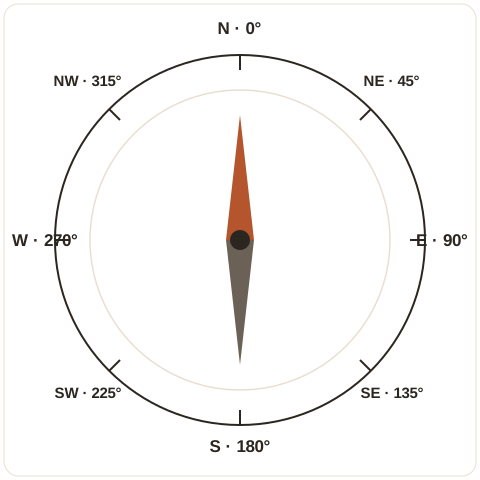
Use a compass to find the sector rather than guessing; the compass reading guide explains how. And keep the fountain away from the front door's direct line: tradition holds that water flowing straight out of the door carries prosperity out with it, and practically, a fountain in the doorway's path is a tripping and splashing hazard.
Size: smaller than you think
Buy smaller than your first instinct. A tabletop fountain — 20 to 40 centimeters tall, holding a liter or two — suits a side table, a console, or a desk in a home office. A floor fountain should be no taller than a side table and should sit against a wall, not in the middle of a room. The reason is not only visual: a large fountain evaporates more water (raising humidity), makes more noise, needs a larger pump (which fails more noticeably), and takes longer to clean. A small fountain you clean monthly beats a grand fountain you abandon after the first algae bloom.
Material matters for sound and maintenance. Ceramic and stone give a soft, natural trickle and hide mineral deposits reasonably well. Metal looks modern but shows water spots and can sound sharper. Resin is light and cheap but often sounds hollow. Whatever the material, check the basin depth: shallow basins splash, evaporate fast, and run dry quickly, which burns out pumps. A basin that holds the pump fully submerged with room to spare is the single best predictor of a long-lived fountain.
Sound: the test before you buy
Sound is the make-or-break quality, and it cannot be judged from a product photo. If you can, hear the fountain running before buying — in a shop, or via a video with the sound on. What you want is a soft, irregular trickle, like a small stream: water falling a short distance onto a stone or into a basin. What you do not want is a loud splashing, a high-pitched dribble, or a pump hum that sits underneath everything. Pump hum is the most common complaint, and it usually means the pump is vibrating against the basin — a small foam pad under the pump often fixes it, and a pump that rattles after cleaning probably needs replacing.
Sound also depends on water level. Most fountains get louder as the water drops, because the fall distance grows. Topping up every few days keeps the sound steady and the pump submerged. If the fountain will run while you work nearby, test it at your desk distance, not at shop distance: a sound that is charming from two meters can be distracting from half a meter. A fountain with adjustable flow is worth paying extra for, because flow control is sound control.
Cleaning: the routine that decides everything
Fountains do not stay clean by themselves. Tap water leaves mineral deposits, still corners grow algae and slime, and a dirty fountain smells faintly swampy — the opposite of the fresh, calm effect you bought it for. The routine is simple: top up evaporated water every few days with fresh water (distilled water reduces mineral buildup dramatically), and every two to four weeks, empty the fountain, scrub the basin, clean the pump intake, and refill. White vinegar dissolves mineral scale; a small brush reaches pump crevices. If the flow weakens or the pump rattles, cleaning is overdue — do it before assuming the pump is broken.
Watch humidity in the first weeks, especially in a small or poorly ventilated room. A small fountain adds very little moisture, but if windows start condensing or books near the fountain feel damp, the fountain is too large for the room or the room needs more ventilation. Move the fountain or ventilate more; do not let dampness linger, since damp damages walls and books far faster than any symbolic benefit repays.
Chosen small, placed in the North, East, or Southeast of a living area, heard before buying, and cleaned monthly, an indoor fountain is one of the lowest-effort, highest-reward features in feng shui: moving water, gentle sound, and a room that feels alive. Run it during the day, switch it off at night, and let it do its quiet work.
Go deeper with the book
Feng Shui Made Simple covers every room this way — bedroom, living room, kitchen, office, entryway — with diagrams and a 7-day plan for doing the whole house.
Frequently asked questions
Where should an indoor fountain go?
Traditionally in the North, East, or Southeast sectors, which suit or are nourished by the Water element. The living room or entryway is the usual room. Avoid the bedroom, where the sound disturbs sleep, and the South, a Fire sector.
How big should an indoor fountain be?
Small enough to be a feature, not a fixture: a tabletop fountain for a desk or side table, a floor fountain no taller than a side table for a living room. A fountain that dominates the room also dominates its humidity and its noise.
Will a fountain make my home damp?
A small, well-placed fountain adds very little humidity, but a large fountain in a small, poorly ventilated room can. Keep the room ventilated, place the fountain away from books and electronics, and watch for condensation in the first weeks.
How often do I need to clean an indoor fountain?
Top up the water every few days as it evaporates, and clean the basin and pump every two to four weeks. Slimy water, a weak flow, or a rattling pump all mean cleaning is overdue.
Can a fountain go in the bedroom?
No — not even a small one. The sound that soothes by day disturbs sleep by night, and bedrooms should stay calm and still. If you want water sounds for sleep, use a timed sound machine instead, which you can switch off.