Guest Room Feng Shui: Make Visitors Feel Welcome
A guest room sends a message, and guests read it instantly. A room with a made bed, a clear surface, a lamp that works, and space for a suitcase says: you belong here, take your time. A room with a bed buried under storage boxes, a dead lamp, and nowhere to put anything says: you are an interruption, and we were not expecting you.
Most guest rooms fail not from malice but from drift. The spare room is the easiest place to put things that have no other home, and over months it quietly becomes a storage unit with a bed in it. The fix is a reset plus a small set of habits that keep it guest-ready. This guide covers both.
The standard is simple: could a friend arrive tonight, with no warning, and sleep well? If yes, the room works. If the honest answer involves an hour of moving boxes, it does not — yet.
The bed: same rules, warmer execution
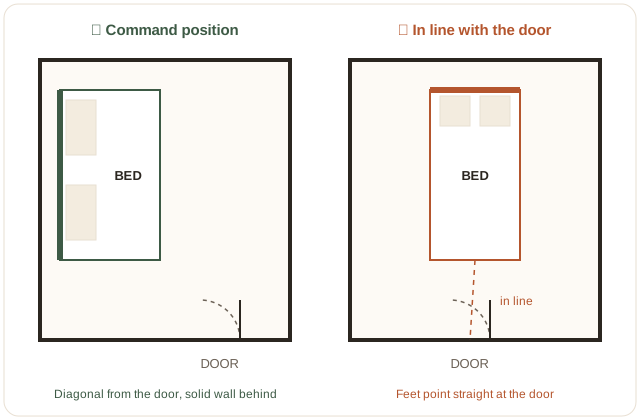
The guest bed follows the same placement rules as any bedroom bed: command position (seeing the door, not directly in line with it), headboard against a solid wall, and clear space underneath. Guests are sleeping in an unfamiliar house; feeling safe matters even more for them than for you.
Bedding should be fresh, neutral, and complete: clean sheets, a blanket plus a lighter layer (guests run hot and cold differently from you), two pillows of different firmness if you can manage it, and a spare blanket in the closet. Neutral colors — white, cream, soft grey, gentle blue — suit almost everyone and make the room feel clean. Save the bold patterns for your own bedroom.
If the guest bed is a sofa bed or a fold-out, test it yourself for a night before inflicting it on anyone. Many sofa beds are fine for one night and miserable for three. A thin mattress topper stored nearby transforms most of them, and it costs less than a dinner out.
What to provide: the guest kit
Guests need a small set of things, and providing them in advance is the difference between a polite stay and a comfortable one. Keep a basket or a cleared drawer with: fresh towels, a spare phone charger, a small bottle of water, and basic toiletries. Add a bedside lamp with an easy switch, a clock, and a notepad and pen — small things, but guests notice every one of them.
Space matters as much as supplies. Clear at least one drawer and a section of closet rod, and leave a luggage rack or a clear chair for the suitcase. A guest who lives out of a suitcase on the floor for three days feels like a visitor in the worst sense — temporary and in the way. A guest with a drawer and a place to hang things feels like they have a room.
Wi-Fi deserves a card, not a shouted password. Write the network name and password on a small card by the bed. It saves the awkward "what's your Wi-Fi again?" dance, and it signals that you expected your guest and prepared for them.
Privacy: the part hosts forget
Privacy is the guest room's most underrated feature. A door that locks or at least latches properly, curtains or blinds that actually close and actually darken, and a clear agreement about bathroom use — these are the things guests remember. A guest room with sheer curtains facing a neighbor's window is not a guest room; it is a stage.
Sound matters too. If the guest room shares a wall with the living room TV or the early-morning kitchen, a white-noise machine or a small fan gives guests control over their soundscape. A rug under the bed softens footsteps for the room below. These are cheap fixes for the two complaints guests almost never voice: "I could hear everything" and "I felt watched."
Give guests a key or a code if they will come and go alone, and tell them the house basics once, clearly: how the shower works, where the towels are, what time breakfast happens, and whether they should help themselves in the kitchen. Guests would rather be told than guess, and guessing wrong is embarrassing for everyone.
What to remove
- Your storage. The ironing board, the out-of-season clothes, the boxes marked "misc." If it lives in the guest room permanently, the room is not a guest room. Move it, or at least consolidate it into one closed closet guests never need to open.
- Personal clutter. Old magazines, half-finished projects, the treadmill. Guests do not want to sleep in your to-do list.
- Family photos of strangers. A few calm pictures are welcoming. A wall of your extended family staring at a stranger in bed is not. Keep the imagery neutral and calm.
- Broken things. The lamp that flickers, the drawer that sticks, the wobbly nightstand. Guests will not tell you; they will just sleep badly and remember. Fix them before anyone arrives.
- Strong scents. Air out the room before guests arrive. Heavy air freshener or a dusty, closed-up smell is worse than no scent at all. Fresh air and clean bedding are the only fragrance a guest room needs.
When the guest room doubles as something else
Most spare rooms earn their keep as offices, craft rooms, or reading nooks between guests. That is fine — the rule is that the guest function must win within thirty minutes. Keep a "guest reset" routine: clear the desk into one drawer, make the bed properly, put out towels and the Wi-Fi card, open the window. If the reset takes longer than thirty minutes, the room has too much non-guest stuff in it, and something needs to move out permanently.
A home office that doubles as a guest room works best when the desk faces away from the bed or sits behind a screen, so the guest is not staring at your work while trying to sleep. A room divider, a tall bookshelf, or even a curtain on a ceiling track can give the bed its own zone without any building work.
No spare room at all? A sofa bed in the living room can still be a good guest experience if you apply the same kit: fresh bedding stored nearby, a lamp, towels, a private corner, and the living room tidied before bedtime. Guests remember being cared for, not square footage.
Start here: walk into your guest room as if you were arriving tonight. Sit on the bed. Look for a lamp, a plug socket, a place for your bag, and a curtain that closes. Whatever is missing is your to-do list, and most of it costs nothing but an hour.
Go deeper with the book
Feng Shui Made Simple covers every room this way — bedroom, living room, kitchen, office, entryway — with diagrams and a 7-day plan for doing the whole house.
Frequently asked questions
What should I put in a guest room?
Fresh neutral bedding, towels, a spare phone charger, water, basic toiletries, a working bedside lamp, a clock, and a card with the Wi-Fi password. Clear a drawer and closet space, and leave somewhere for the suitcase — a rack or a clear chair.
Where should a guest bed go?
In the command position: the guest can see the door from the pillow but is not directly in line with it, with the headboard against a solid wall. Guests sleep in an unfamiliar house, so feeling safe matters even more for them.
How do I keep a guest room from becoming storage?
Set a rule: the guest function must win within thirty minutes. Keep a guest-reset routine — clear the desk into one drawer, make the bed, put out towels, open the window. If the reset takes longer, something non-guest needs to move out permanently.
What if I have no spare room?
A sofa bed in the living room works if you apply the same kit: fresh bedding stored nearby, a lamp, towels, a private corner, and the room tidied before bedtime. Guests remember being cared for, not square footage.
Should a guest room have a lock?
A door that latches properly at minimum, and a lock if you can add one. Privacy — a door that closes, curtains that actually darken, and clear bathroom arrangements — is the thing guests value most and complain about least.