Floor Level Feng Shui: Ground, Middle, or Top?
Ask ten people which floor is best and you will get ten confident answers — and most of them will be describing their own floor. The truth is less dramatic and more useful: every floor has a different trade-off, and the right floor is the one whose trade-offs you are happiest living with. This guide compares ground, middle, and top floors honestly, on the things that actually affect daily life.
Traditional feng shui has a view on height: being too low is seen as exposed to the rush of the street, while being very high is seen as disconnected from the ground's stability — the Earth element that grounds a home. The middle is traditionally favored as balanced. That old preference lines up surprisingly well with the practical evidence, as you will see below. But tradition is a starting point here, not a verdict: a top floor with a leaking roof is a bad home, and a ground floor with a private garden is a wonderful one, whatever the old books say.
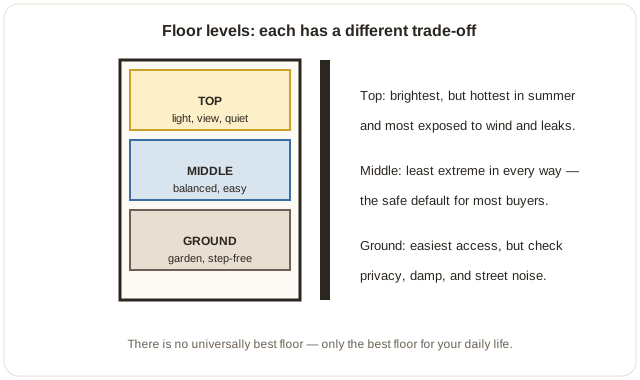
Judge each floor on five things: light, noise, privacy, temperature, and access. Every floor wins some and loses others.
Ground floor: easiest access, most exposure
The ground floor's greatest strength is access. No lift, no stairs, no waiting: you walk in with groceries, a bicycle, a wheelchair, or a sleeping child without a second thought. For older residents, people with mobility problems, and families with small children and strollers, this alone can decide the choice. Ground floors also often come with the building's only private outdoor space — a garden, a terrace, or a patio — which is worth more than any interior feature in a city apartment.
The costs are exposure and environment. Street noise is loudest at ground level, and so is dust. Privacy is weakest: passers-by can see in, so ground-floor windows need curtains or frosted glass, and the curtains guide becomes essential rather than optional. Damp is the third concern — ground floors are closest to the earth's moisture, so check for damp patches, musty smells, and the building's drainage during a viewing, especially in older buildings.
Security deserves a mention too. Ground floors need better locks, window security, and lighting than upper floors, because they are reachable from the street. None of this makes a ground floor a bad choice — millions of people love theirs — but it is a checklist to work through before signing, not after.
Middle floors: the balanced default
Middle floors are the least extreme in every way, and that is their virtue. Street noise is reduced but not gone; light is decent without the top floor's glare; privacy is better than the ground floor without the top floor's wind; temperature is the most stable in the building, because neighboring flats insulate you above and below. If you have no strong reason to prefer the top or the ground, a middle floor is the safest choice — and "safest" here means fewest surprises.
There are still things to check. A middle floor beside a lift shaft or a rubbish chute gets noise that has nothing to do with the street. A middle floor whose windows face another building a few meters away gets little light and less privacy. And in a tall building, a middle floor is still lift-dependent — check the lift's reliability and the staircase alternative, because a broken lift on the eighth floor is a different problem from a broken lift on the second.
Middle floors also tend to hold their value well, because they suit the widest range of buyers: not too high for the lift-wary, not too low for the privacy-conscious. If resale matters to you, that breadth of appeal is a real, practical advantage — and the selling guide notes the same broad-appeal logic for other features.
Top floor: light, quiet, and heat
The top floor's appeal is immediate when you walk in: more light, a better view, less street noise, and a feeling of being above the city's rush. For many people, that feeling alone is worth the price. Top floors also get the least noise from neighbors above — because there are none — which is a genuine quality-of-life advantage in buildings with thin floors.
The costs are heat, wind, and water. Heat rises, and a top floor under a poorly insulated roof can roast in summer — visit on a hot day if you can, or ask the current residents directly about summer temperatures. Wind is stronger at height, which matters for balconies and for windows that rattle. And the roof is your ceiling: a leak is your problem in a way it never is for a middle floor, so check the roof's age, the building's leak history, and whether the top floor has had water damage.
Lift dependence is the top floor's other cost. A broken lift is an inconvenience on the third floor and a serious problem on the fifteenth, especially with groceries, children, or limited mobility. If you choose a top floor, make sure the building has a reliable lift and a usable staircase, and that you are comfortable using both.
Choosing for your life, not for a rule
Match the floor to your daily life. Work nights and sleep days? A top floor's quiet and blackout-friendly darkness may matter more than its summer heat. Have small children, a dog, or mobility needs? A ground floor's step-free access and garden may outweigh its noise. Work from home and take calls all day? A middle floor's stable temperature and moderate noise may be the best background for your working hours — the home office guide covers the rest of that setup.
Also consider the building, not just the floor. A well-built building with good insulation, double glazing, and a sound roof flattens the differences between floors; a poorly built one exaggerates them. A ground floor in a solid building beats a top floor in a leaky one, and a middle floor in a noisy building is still noisy. When choosing an apartment, judge the building's condition alongside the floor's character.
Finally, remember that floor level is separate from the year's star map. Annual flying stars are mapped by sector of the home — in 2027, for example, the north holds 5 Yellow and the west holds 2 Black with San Sha; in 2028, the southwest holds 5 Yellow with Tai Sui — and those sectors sit in the same compass positions on every floor. Your floor affects your light, noise, and comfort; the stars affect which sectors need care that year. Both matter, and neither replaces the other.
A viewing checklist by floor
For a ground floor, check: privacy from the street, street noise with the windows closed, damp patches and drainage, window security, and the quality of the outdoor space. For a middle floor, check: noise from the lift and neighbors, light and outlook from the windows, and lift reliability. For a top floor, check: summer heat, roof condition and leak history, wind on the balcony, and the staircase alternative when the lift fails.
Whichever floor you choose, live with the trade-off consciously. The top floor's heat is easier to bear when you chose it knowingly and fitted shading; the ground floor's noise is easier to bear when you chose it for the garden and fitted good curtains. The worst floor is not the top or the ground — it is the one whose costs surprise you after you have signed.
Go deeper with the book
Feng Shui Made Simple covers every room this way — bedroom, living room, kitchen, office, entryway — with diagrams and a 7-day plan for doing the whole house.
Frequently asked questions
Which floor is best for feng shui?
There is no universally best floor. Middle floors are the balanced default — least extreme in light, noise, heat, and access. Top floors suit people who value light and quiet; ground floors suit people who value step-free access and outdoor space. The best floor is the one that fits your daily life.
Is a ground-floor apartment bad feng shui?
Not necessarily. Ground floors are traditionally seen as more exposed to street energy, but they offer step-free access, often a garden, and the easiest move-in. Check privacy, damp, and street noise during a viewing — if those are handled, a ground floor can be an excellent home.
Is a top-floor apartment bad feng shui?
No. Top floors get the most light and the least street noise, which many people love. The practical concerns are heat in summer, exposure to wind, roof leaks, and lift dependence. Check the roof's condition and the summer temperature before deciding.
Does floor level matter for the annual flying stars?
Annual flying stars are mapped by sector of the home — for example, in 2027 the north holds 5 Yellow and the west holds 2 Black with San Sha — not by floor level. Floor level affects light, noise, and comfort, which are separate from the yearly star map.
What should I check on a top floor in summer?
Heat, above all. Visit on a hot day if you can, or ask the current residents about summer temperatures. Check for roof insulation, whether windows open on two sides for a through-draft, and whether the building has a history of leaks. A top floor that roasts all summer is a daily cost, not a minor flaw.