Feng Shui for Career Growth and Promotion
Promotions are not handed out for tidy desks. They are handed out for visible, finished, reliable work — and for the confidence with which you present it. That said, where you work shapes how you work, every single day.
A desk that faces a wall, a chair with your back to the door, a workspace buried in piles, a room so dark you need to squint — each of these costs a little focus, a little calm, a little willingness to start. Added up over months, that is a real career cost. This guide is about removing those costs. One clear statement up front: no arrangement guarantees a promotion, a raise, or a new job. What a good workspace does is support the habits promotions are built on — focus, follow-through, and calm confidence — and get out of their way.
The command position: the single most important change
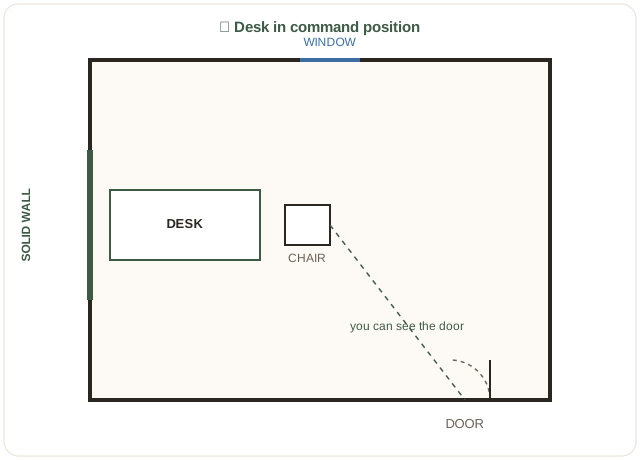
Place your desk so that you face the door of the room, with a solid wall behind you. This is the command position, and it is the most repeated rule in feng shui for a reason that has nothing to do with mysticism: when you can see who enters without turning around, your nervous system relaxes. You are not startled by footsteps behind you. You do not keep half an ear on the door. That freed attention goes into your work.
The wall behind you matters too. A solid wall is support you can feel: nobody can walk up behind you, and your chair is anchored rather than floating in the middle of the room. If your room makes the full command position impossible — a small room, a shared space — use the best available version: angle the desk so the door is in your peripheral vision, and put a solid piece of furniture, like a bookcase, behind you instead of open space. The home office guide covers the variations.
What not to sit in
Three positions quietly undermine a workday. First, back to the door: you spend the day half-listening for entrances, and every visitor startles you. Second, facing a blank wall inches away: your eyes have nowhere to rest, and the workday feels like a box. If the wall is unavoidable, hang something with depth — a landscape, a window-like print — and keep the desk far enough from the wall that you can lean back. Third, under a beam or facing a sharp corner: the beams guide and the poison arrows guide explain why these feel oppressive, and the fixes are simple — move the desk, soften the corner with a plant, or cover the beam's edge.
Also avoid working from the bed or the sofa as a habit. Your body learns associations: bed means rest, sofa means relaxation, desk means work. When you blur those, both work and rest suffer. If space forces a shared surface, use a ritual to mark the switch — a desk mat that comes out for work and goes away after, a lamp that is only on during work hours. The ritual is the boundary.
The north sector: career in the bagua
In the bagua map, career is the north sector, and its element is Water — black and deep blue, wavy and flowing shapes, the quality of depth and steady movement. Keep the north of your home tidy, with a clear path and nothing broken or stagnant sitting there. A small water feature can suit the north if you like one and will maintain it; a stagnant, dusty one does the opposite, so the water features guide is worth reading before you buy. The north sector guide covers the sector in full.
Metal produces Water in the generating cycle, so white, silver, and gold accents also support the north — a metal frame, a white shelf, a round mirror. Keep the north calm rather than stimulating: this is the sector of depth and direction, not display. A north that is quiet and organized supports the feeling of a career with a direction, rather than a career that is merely busy.
Light, air, and the working body
Career advice rarely mentions light, but your workspace light decides how long you can focus. Natural daylight from the side — not glaring into your eyes or onto your screen — is best. If you face a window, use a sheer curtain to soften glare; if your back is to a window, beware of screen reflection and of the exposed-back feeling, and close the gap with a solid chair back and a bookcase behind you. For evening work, use layered light: a desk lamp for the task, a softer room light so the screen is not a bright island in a dark room. The light guide covers layering in detail.
Air matters as much: open the window daily, even briefly, and keep plants only if you will water them — a dying plant on a desk is a small daily discouragement. Keep water at your desk, keep the chair at a height where your feet rest flat, and keep the desk surface clear enough that your current task is the only thing demanding attention. Ergonomics is feng shui for the body, and a body in pain does not do promotable work.
Making your work visible
Promotions reward visible results, so give your results a visible place. A shelf for finished work, a wall for certificates or kind feedback, a notebook where completed projects are logged — these are not vanity. They are a record, for you, of what you have actually done. On a bad week, that record is what stops you from believing you have done nothing. On a review week, it is what you draw on when you write your self-assessment.
Keep the record honest and current: remove outdated items, update the log monthly, and keep the display small. A wall covered floor-to-ceiling in old awards looks like a museum; one shelf of current, meaningful evidence looks like a professional at work. The same rule applies to your digital desktop: a tidy screen, filed documents, and an inbox you process daily are the digital equivalent of a clear desk, and they are what colleagues and managers actually see when you share your screen.
A career routine for the space
- Morning: clear the desk, open the window, and write the day's single most important task on paper before opening email.
- During work: keep the door in view, the phone face-down for focus blocks, and water within reach.
- End of day: clear the desk, file loose papers, and write tomorrow's first task. Leave the workspace ready, not abandoned.
- Weekly: log one finished piece of work in your record, and tidy the north sector of your home.
None of this will promote you by itself. Promotions come from work done well, relationships kept in good repair, and timing you cannot control. But a workspace that supports focus, calm, and visible results removes the daily friction that quietly holds good work back — and that is a contribution worth making, one desk position at a time.
Go deeper with the book
Feng Shui Made Simple covers every room this way — bedroom, living room, kitchen, office, entryway — with diagrams and a 7-day plan for doing the whole house.
Frequently asked questions
Where should my desk face for career feng shui?
Face the door of the room with a solid wall behind you — the command position. You can see who enters without turning around, which helps you stay calm and in control. Avoid sitting with your back directly to the door or facing a blank wall inches from your face.
What is the career sector of the bagua?
The north sector, whose element is Water. Its colors are black and deep blue, and its shape is wavy or flowing. Keep the north of your home tidy and uncluttered, with a clear path through it.
Can feng shui get me a promotion?
No arrangement guarantees a promotion, a raise, or a new job. What a good workspace can do is support the things promotions are actually built on: focused work, visible results, calm confidence in meetings, and the habit of finishing what you start.
I work at a kitchen table, not an office. Does this still apply?
Yes, in miniature. Choose the seat that faces the room, keep your work zone clear during work hours, and pack it away when work ends. A defined start and end to the workday matters more than a separate room.