Cul-de-Sac Houses: Calm Street, Stuck Energy?
A cul-de-sac is the street most families say they want: no through traffic, children playing out front, neighbours who know each other. Feng shui tradition, though, has a reservation about it — a road that ends has energy that arrives and then has nowhere to go. Is that a real problem, or just a poetic way of describing a quiet street?
The honest answer is that it is both. A cul-de-sac really is quieter and safer than a through road, and those are genuine quality-of-life wins. But a dead-end street does have a real tendency toward stillness: less passing trade, less breeze through the turning circle, fewer reasons for anyone to come down the road at all. The trick is to keep the calm without letting the place feel forgotten.
Why tradition is wary of dead ends
In feng shui, a healthy home has energy that arrives, circulates, and leaves — like fresh air through a house. A cul-de-sac breaks that pattern at street level: everything that comes down the road must turn around and go back the way it came. Tradition reads that as stagnation, and links it to a household that feels stuck — same routines, few visitors, slow change.
Strip away the symbolism and there is a practical core. Streets with no through route get less foot traffic, so neighbours meet less by chance; the turning circle at the end collects parked cars and fallen leaves; and because the road serves only its own residents, the council and delivery drivers have less reason to pass. None of this is dramatic, but together it can make the end of a cul-de-sac feel cut off, especially in winter. The fixes are about movement and connection, not magic.
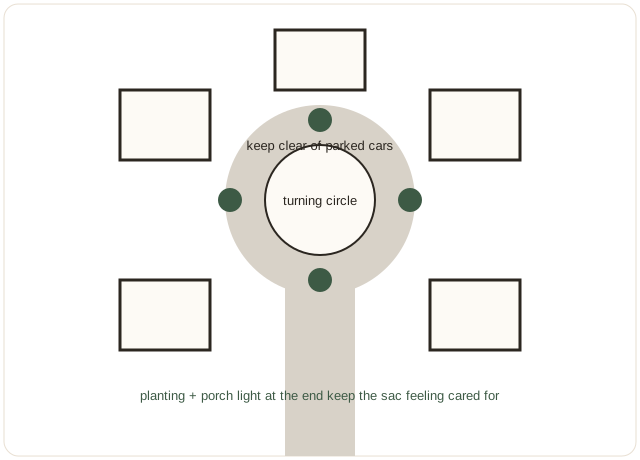
Where your house sits on the sac matters
Not all cul-de-sac plots are equal. The house at the very end, facing the turning circle, gets the most of everything: the most turning cars, the most headlights sweeping across the front, and the most of the stillness. Houses partway down the sac, on either side, get most of the quiet with less of the turning-circle exposure.
If you are at the end, the T-junction advice applies in miniature: a hedge or planted border softens the turning circle, and a curved path keeps the approach from feeling like a dead stop. See the T-junction guide for the full version of those fixes. If you are midway down, your main job is different — it is making sure your house does not fade into the background of a street nobody passes through.
Keep the front alive
The best antidote to stillness is use. A front garden that is visibly tended — flowers in season, a swept path, a bench by the door — signals a lived-in house to everyone on the street, and it gives you a reason to be out front meeting neighbours. Contrast that with a front garden that is paved over for parking and never touched: it reads as a house that has given up on its street.
Light matters more here than on a busy road. A dark cul-de-sac end feels isolated after dark, so a warm porch light on a timer or sensor is worth more than decoration — it marks your house as occupied and welcoming, and it lights the turning circle for everyone. Inside, the same principle applies: keep the front rooms lit in the evening rather than retreating to the back of the house, so the house presents a lived-in face to the street.
Air, movement, and the inside of the house
A still street can make a still house. If your home sits at the end of a dead-end road, be deliberate about through-movement indoors: open windows on opposite sides when the weather allows, so air genuinely crosses the house instead of sitting. Our small spaces guide has the same cross-ventilation advice for flats, and it applies just as well here.
Movement also means people. Cul-de-sac neighbours tend to become close — or not to meet at all, because there is no passing traffic to force chance encounters. If you want the close version, create the excuse: a front-garden chat, a shared bulb-planting afternoon, a door left open on a summer evening. The street layout will not do this work for you; the layout gives you quiet, and you supply the connection. The entryway guide covers making the threshold itself inviting, which is where neighbourly contact starts.
Parking and the turning circle
The practical headache of cul-de-sac life is parking. The turning circle is not a car park, but it gets used as one, and a ring of parked cars makes the end of the street feel cramped and blocks the very turning space that makes the layout work. Keep your own cars on your drive or in the garage, and keep the turning area clear — it is the shared breathing space of the street, and when it is clear, the whole sac feels more open.
If the turning circle is outside your front window, a low hedge or a row of planters along your boundary stops headlights from sweeping the front rooms when neighbours turn, and it marks your plot clearly without fencing yourself off. Planting that is maintained beats a fence that is not, because a neglected fence at the end of a quiet street is the stillness problem made visible.
The verdict: a good layout, honestly kept
A cul-de-sac is a good place to live, with one maintenance cost: you have to supply the movement and connection that a through road supplies automatically. Tend the front, light the porch, open the windows across the house, and know your neighbours. Do those four things and the stillness stays a virtue — quiet, safe, and calm — instead of drifting into stagnation.
If you are choosing between a cul-de-sac house and a through-road house, weigh what you actually value. Through roads bring passing life and easier resale; cul-de-sacs bring safety and quiet. Neither is wrong. The cul-de-sac simply asks a little more of its residents, and in return it gives children a street to play in and neighbours a reason to know each other.
Go deeper with the book
Feng Shui Made Simple covers every room this way — bedroom, living room, kitchen, office, entryway — with diagrams and a 7-day plan for doing the whole house.
Frequently asked questions
Is it bad feng shui to live in a cul-de-sac?
Tradition is cautious because energy arrives at a dead end and must turn back, which is read as stagnation. In practice the real issues are quietness tipping into isolation and the turning circle collecting parked cars. Both are manageable with a tended front garden, good lighting, and neighbourly contact.
Which position in a cul-de-sac is best?
Midway down either side is usually the sweet spot: quiet without the turning-circle exposure. The house at the very end gets the most turning cars and headlights, so it benefits most from a hedge and a curved path.
Does a cul-de-sac hurt resale value?
Generally the opposite — family buyers often pay a premium for cul-de-sac safety and quiet, especially near schools. The exception is the end house if the turning circle is dominated by parked cars, which is a presentation problem you can help fix by keeping your own parking on your drive.
How do I stop a cul-de-sac house feeling cut off?
Use the front of the house: a tended garden, a porch light on in the evening, and front rooms that are lived in, not shuttered. Open windows across the house for air movement, and make the small effort to know your neighbours — the street layout will not create those encounters by itself.
Is a cul-de-sac worse than a T-junction?
They are different problems. A T-junction faces traffic head-on; a cul-de-sac faces stillness. The T-junction needs screening from the road, the cul-de-sac needs signs of life. Most people find the cul-de-sac's problem much easier to live with.