Clocks in Feng Shui: Time, Sound, and Placement
A clock is the only object in your home that never stops talking. Even a silent one speaks: it tells you whether you are late, how long the afternoon has left, and how much of your life is passing in this room. That is why feng shui treats clocks with unusual care. They are not decorations. They are instruments, and where you put them changes how a room feels.
Traditional feng shui associates clocks with movement and the passage of time. A working clock suggests a household that is alive and moving forward; a stopped clock suggests the opposite — something that should be flowing has stalled. You do not need to believe in the symbolism to feel the practical effect: a dead clock on the wall is a small lie you glance at several times a day, and small daily lies are quietly tiring.
This guide covers the three things that actually matter about clocks: where to hang them, what sound they make, and whether they are working. Get those three right and the rest — style, size, brand — is personal taste.
Where clocks belong
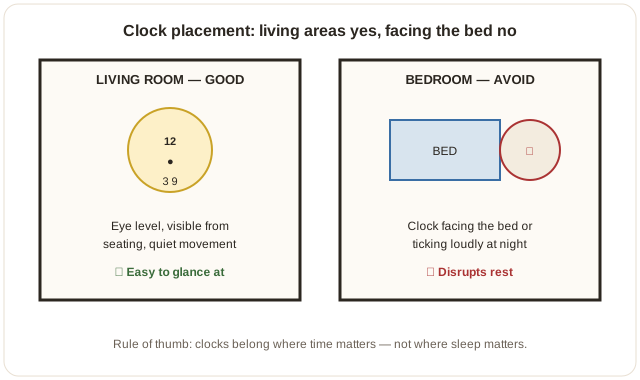
Clocks belong where time matters. The living room is the classic spot: one clock, at eye level, visible from the main seating without turning your head. The kitchen is the second good spot, because cooking runs on timing and a cook should not have to hunt for a phone with wet hands. A home office is the third, for the same reason — work runs on schedules, and a visible clock keeps meetings honest.
Notice the pattern: these are active rooms, rooms where people do things on a schedule. A clock there is a tool, and tools belong where the work happens. The same logic explains where clocks do not belong, which brings us to the bedroom.
The bedroom rule
Keep wall clocks out of the bedroom if you can, and if you cannot, keep them off the wall facing the bed. The traditional reason is that a clock facing the bed points time pressure directly at the sleeper. The practical reason is simpler and stronger: the bedroom is the one room whose job is rest, and a clock is an object whose job is urgency. The two jobs conflict.
Sound is the bigger issue. A ticking clock in a quiet bedroom is surprisingly loud at 2 a.m., when the house is silent and your brain has nothing else to listen to. People adapt to daytime noise; they do not adapt to a metronome beside their pillow. If you sleep in a room with a ticking clock and you wake often, try removing the clock for a week before you try anything else. It is the cheapest sleep experiment you will ever run.
Bright digital displays are the same problem in visual form. A glowing red 03:47 is not restful, and checking it turns a brief wake-up into a calculation about how little sleep remains. If you need an alarm, use one with a dimmable display turned away from the bed, or keep the phone in a drawer and let the room stay clock-free. See the bedroom guide for the rest of the sleep-friendly setup.
Sound: ticking, chiming, and silence
Sound is the most underrated part of clock feng shui, because it is the part you cannot see. A clock's sound is a permanent background presence in a room, and permanent presences shape mood more than occasional ones do. This is why sound is treated as a cure in its own right — the right sound lifts a room, and the wrong sound grates on it day after day.
Silent-movement (also called sweep or continuous-sweep) clocks are the default recommendation for most rooms. They give you the information without the soundtrack. They cost little more than ticking clocks and they remove the single most common clock complaint entirely. If you already own a ticking clock you love, keep it in a room with enough daytime activity — a living room or kitchen — where its tick disappears into the general hum, rather than in a study or bedroom where quiet is the point.
Chiming clocks are a different matter. A grandfather clock or a wall clock that chimes the hour adds genuine character to a hallway or living room, and many families love the ritual of it. The test is simple: does anyone in the house flinch, wake, or complain about the chime? If the answer is yes, the chime goes, however beautiful the clock. A beautiful object that annoys someone daily is not good feng shui, whatever tradition says about it.
Stopped clocks, broken clocks, and clutter
The feng shui rule about stopped clocks is blunt: fix them or remove them. A clock with a dead battery is not a decoration; it is a broken tool on display, and broken things on display send a quiet message that maintenance does not matter here. The same rule applies to clocks with cracked faces, bent hands, or faded dials — and to everything else broken in the house, as the myths guide notes when it separates real principles from superstition.
This is also a good moment to count your clocks. One per living area is plenty. Homes accumulate clocks the way they accumulate mugs: a gift here, a bargain there, a phone, a microwave, an oven, a watch — suddenly every wall reports the time and the house feels like a station concourse. Every wall reminding you of the hour is not helpful; it is hurried. Pick the best clock for each active room and move the rest to a drawer or out of the house.
While you are at it, check that your clocks agree. Two clocks in one room showing different times is a small, constant source of low-level confusion — which one is right? — and it makes the household feel slightly disorganized. Synchronize them, or keep only one.
Shape, material, and direction
Shape and material are where tradition meets taste, and taste should win unless a choice is actively working against the room. Round clocks are the most common recommendation, because a circle has no sharp corners and reads as complete and harmonious — the same reason round dining tables are favored. Square or rectangular clocks are perfectly fine in rooms with strong straight lines, like a modern living room or office. The shape matters far less than the placement and the sound.
Material can quietly support a room's element balance. A metal-framed clock suits a room that needs Metal's clarity and order — an office, for instance — while a wooden frame warms a living room. These are gentle associations from the five elements, not rules to agonize over: if you love a clock, its material is already right for you, and no element chart should talk you out of it.
One placement rule is worth keeping: avoid hanging a clock directly facing the front door, so it is the first thing a visitor sees on entering. Tradition says time rushing toward the door pushes energy straight back out. Practically, it makes arrivals feel hurried — the first thing you see is a reminder of the hour. Hang the entryway clock on a side wall instead, where it is useful without being confrontational. The entryway guide covers the rest of that first-impression zone.
A quick clock audit
Walk your home with this list, room by room. It takes ten minutes. First, is every clock working, with a fresh battery or a wound movement? Second, is there a ticking or chiming clock in any bedroom or quiet study? Third, is there a clock facing the front door or facing a bed? Fourth, does any room have two clocks showing different times? Fix what you find: replace a battery, move a clock to a side wall, swap a ticking movement for a silent one, or take a surplus clock down entirely.
That is the whole of clock feng shui. It is not about buying a special clock or placing one in a lucky corner. It is about making sure the objects that measure your time are working, quiet, and placed where time is actually useful — and letting the rooms meant for rest stay free of urgency.
Go deeper with the book
Feng Shui Made Simple covers every room this way — bedroom, living room, kitchen, office, entryway — with diagrams and a 7-day plan for doing the whole house.
Frequently asked questions
Is it bad feng shui to have a clock in the bedroom?
A clock is not bad luck in a bedroom, but a ticking clock or a bright display can disturb sleep, and a clock facing the bed keeps time pressure in view at the exact moment you should be letting go of the day. Use a silent-movement clock on a side wall, or keep the phone alarm in a drawer and let the bedroom stay clock-free.
What does a stopped clock mean in feng shui?
Tradition reads a stopped clock as stuck energy: something that should be moving is not. Practically, a dead clock is also a small daily irritation — you glance at it, it lies to you, and you feel briefly disoriented. Either replace the battery or take the clock down; do not leave it hanging as decoration.
How many clocks should a home have?
One per living area is plenty: the living room, the kitchen, and the home office if you work from home. More than that, and the house starts to feel like a station concourse — every wall reminding you of the hour. Bedrooms and bathrooms do not need wall clocks.
Should a clock face the front door?
Avoid hanging a clock directly facing the front door, so it is the first thing a visitor sees on entering. Tradition says time rushing toward the door pushes energy straight back out. Practically, it also makes arrivals feel hurried. Hang it on a side wall of the entryway instead.
Are pendulum clocks or grandfather clocks good feng shui?
They can be, provided the ticking and chiming do not disturb anyone and the clock is kept in working order. A grandfather clock in a living room or hallway adds rhythm and presence to a home. But a loud chime beside a bedroom, or a clock nobody winds, works against the calm it is supposed to bring.