Two Doors Aligned: When Energy Runs Straight Through
Stand in one doorway and look straight through another doorway into the room beyond: that is the aligned-doors pattern, and it is one of the most common layout quirks in houses and flats. Bedroom door facing bathroom door, front door facing back door, two bedroom doors facing each other across a landing — the geometry is the same, and so is the feeling: rooms that should be private feel connected in a way you did not choose.
The practical complaints are easy to list. Aligned doors carry noise straight from one room to another, so a bathroom flush or a television travels further than it should. They carry sightlines, so a bedroom or bathroom is visible from a hallway or another room the moment its door opens. And they carry draughts, since two open doors in a line make a short wind tunnel. Tradition's complaint — energy running straight through without settling — is the same list in symbolic form.
Which alignments matter most
Not every alignment deserves attention. Two doors that are rarely open at the same time, or that connect rooms with no privacy needs — a kitchen and a dining room, say — are not a problem; in fact, aligned doors between sociable rooms can be a pleasure, letting conversation and light flow. The alignments worth fixing are the ones that join a private room to a public route or to another private room: bedroom to bathroom, bedroom to bedroom across a landing, front door to back door, and bedroom to front door in a small flat.
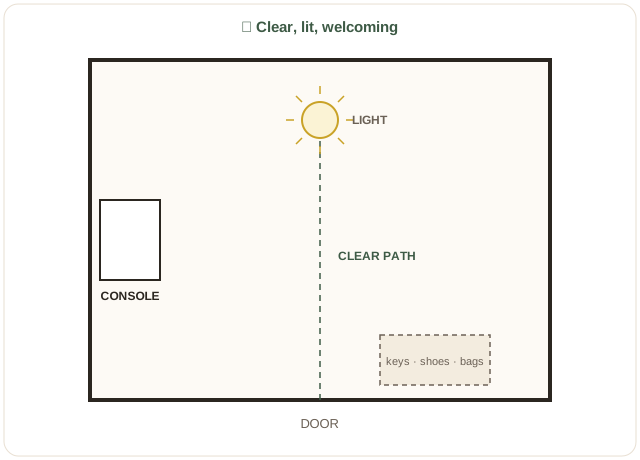
The front-to-back door alignment is the strongest version, because it is the same pattern as the door facing a window, with a door at both ends instead of a window at one. If your front and back doors line up, start with that guide's fixes — a console, a plant, a rug marking the entrance zone — and treat the door-to-door case as the same job with a second door to manage.
Break the line without blocking the route
The fix, as with every straight-line problem, is a gentle deflection, not a barricade. A tall plant beside one of the doors, a small table or a bookshelf set just outside the line, or a rug that marks a zone between the two doors all force the eye to stop and the path to bend slightly. The walking route stays comfortable — keep at least 90 centimetres clear — but the sightline is interrupted, and with it the noise and the draught lose some of their directness.
A door that is usually the problem can also simply be kept shut. This sounds too obvious to count as advice, but it is the fix most people already use without noticing: the bathroom door shut by habit, the bedroom door closed at night. Make it easier by fitting a soft-close or a door that swings shut on its own, and the alignment stops mattering for most of the day. Doors that stay open are usually staying open because they are awkward to close — a sticking hinge or a missing handle — so fix the hardware first.
Curtains, screens, and door furniture
A curtain over one of the aligned doors — a doorway curtain in a bedroom or a bathroom doorway that has no door — is a traditional and effective softener: it breaks the sightline, muffles sound slightly, and can be drawn or tied back as needed. In a rented home, a tension-rod curtain is a no-damage version of the same fix. A folding screen does the same job standing free, and suits a landing where two bedroom doors face each other: a screen at one side of the landing gives both rooms a visual buffer without any building work.
Door furniture matters too. Doors that face each other and are both fitted with glass panels double the problem, since light and sight travel through even when the doors are shut. Frosted film on the glass of one door restores privacy while keeping the light. And if the two doors are different heights or styles — common where an extension meets the original house — the mismatch itself draws the eye along the line; painting both doors the same colour quiets that down.
Bedroom to bathroom: the classic case
The bedroom-door-to-bathroom-door alignment deserves its own paragraph, because it is the one people ask about most and the one with the clearest practical complaint: a bathroom is humid, noisy, and used at night, and a straight line carries all three into the bedroom. Keep the bathroom door shut — an extractor fan that runs on after use helps, since a shut door with a fan still clears humidity — and put a rug or a small table in the space between the two doors to mark the bedroom's threshold. The bathroom guide covers humidity and layout, and the bedroom guide covers protecting sleep from exactly this kind of intrusion.
If the bathroom opens directly off the bedroom — an en-suite with its door in line with the bedroom door — the same fixes apply, plus one more: a full-length mirror or a picture on the wall beside the bathroom door, so the eye lands on something other than the bathroom when the bedroom door opens. The aim is that entering the bedroom feels like entering a room, not like standing in a corridor that happens to have a bed in it.
When alignment is a gift
It is worth saying that aligned doors are not always a flaw. A kitchen door aligned with a dining room door makes serving easy. French doors aligned with a garden door make summer flow beautifully. Doors aligned on a landing can make a small house feel larger, because the eye travels through. The question is never 'are the doors aligned?' but 'does the alignment serve the rooms it joins?' If it serves them, enjoy it. If it leaks privacy, noise, or draughts between rooms that need separation, deflect the line gently — a plant, a screen, a shut door — and the house regains its rooms.
Go deeper with the book
Feng Shui Made Simple covers every room this way — bedroom, living room, kitchen, office, entryway — with diagrams and a 7-day plan for doing the whole house.
Frequently asked questions
Is it bad feng shui for two doors to face each other?
Tradition treats it as energy running straight through. In practice the issues are noise, sightlines, and draughts travelling directly between rooms — worth fixing when the rooms need privacy, harmless when they are sociable rooms.
What is the easiest fix for aligned doors?
Keep one door shut, and put a tall plant or a small table just outside the sightline so the route bends gently. Frosted film on glass panels restores privacy where doors are glazed.
Should bedroom and bathroom doors face each other?
Ideally not, because a straight line carries bathroom humidity, noise, and night-time use into the bedroom. Keep the bathroom door shut, use an extractor fan, and mark the bedroom threshold with a rug or a table between the two doors.
Is a front door facing a back door worse than other alignments?
It is the strongest version, because it runs the full length of the house. Treat it like the door-facing-window pattern: break the line with furniture, a screen, or a plant near the entrance.
Do I need to move a door to fix alignment?
Almost never. Deflection — a plant, a screen, a curtain, a shut door — handles the practical problems. Moving a doorway is building work, and it is rarely needed for what is essentially a sightline and draught issue.