Front Yard Feng Shui: The Path to Your Door
Before anyone sees your living room, they see your front yard. It is the first room of the home, even though it has no walls — the place where a visitor decides, without thinking about it, whether this house feels welcoming or forbidding. In feng shui, the front yard is where energy gathers before it enters: a yard that is open, cared for, and easy to walk through invites energy in, and a yard that is blocked, overgrown, or confusing turns it away.
That may sound abstract, but the practical version is familiar to everyone. A path you cannot find, a gate that sticks, a porch buried behind an untrimmed hedge — all of these make a visitor hesitate, and hesitation is the opposite of welcome. The good news is that front-yard feng shui is mostly gardening, tidying, and common sense, and most of it costs little or nothing.
The path: visible, walkable, and gently curved
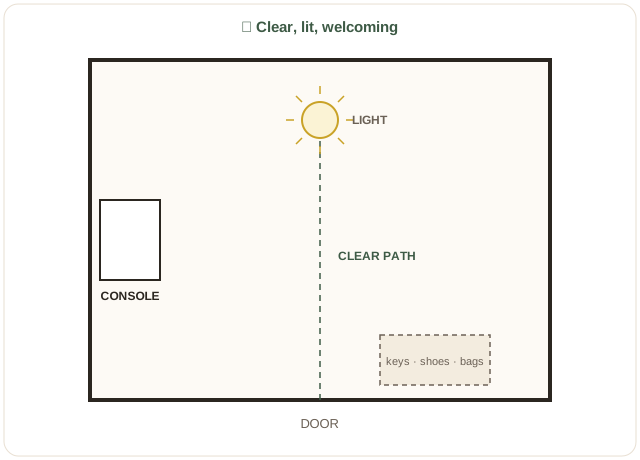
The path from the street or gate to the front door should be obvious at first glance. If a first-time visitor has to guess where to walk, the path has failed, whatever it looks like. Keep it wide enough for two people to walk side by side — about 1.2 meters is comfortable — and keep its surface even, swept, and free of moss, loose gravel drifts, and overhanging branches at head height. A path that forces visitors to duck, pick their way, or balance is a path that says "keep out" even when you mean the opposite.
Tradition prefers a gently curving path over a dead-straight one, and the reason is worth understanding: a straight path rushes the eye — and, in feng shui terms, energy — straight at the door, while a curve slows it and lets it gather. You do not need a serpentine driveway to get this effect. Even a slight bend, or a path that angles past a planting bed before reaching the porch, softens the approach. What matters most is avoiding the extreme version: a long, narrow, straight chute walled in by hedges on both sides, which feels like a corridor to a fortress. If your path is straight, break it visually with a planted bed beside it, a change of paving material halfway, or a pot or two flanking the porch — the same softening principle used inside at the entryway.
The door must be findable
The front door itself should be visible from the path, well lit, and clearly the main entrance — not hidden behind a hedge, not confused with a side gate or garage door, and not painted the same color as the wall around it. A house number that can be read from the street is part of this: visitors, deliveries, and emergency services all need it, and a hidden number is a small daily friction for everyone who comes to the house. If your door faces the street only indirectly — around a corner, down a side passage — a light, a sign, or a pair of pots marking the turn will do more for the home's welcome than any ornament.
Door color is a separate choice, and it can follow either your taste or the compass direction the door faces; the front door color guide covers the directional options in detail. Whichever color you choose, keep the door itself in good repair: hinges that work, a handle that turns cleanly, paint that is not peeling. A sticking front door is a small daily insult to everyone who uses it, and feng shui's rule about fixing broken things starts at the threshold.
Planting: healthy, proportionate, and clear of the door
Healthy plants are the front yard's best asset. They soften hard surfaces, give the approach color and scent, and signal care — a tended garden tells a visitor the household inside is tended too. But proportion matters. A tree that overhangs the roof, drops debris into the gutters, and blocks light from the front windows is not a guardian; it is a maintenance burden, and it darkens the rooms behind it. Keep large trees at a distance from the house, prune anything that touches the roof or brushes the door, and choose shrubs that will stay below window height rather than ones you must fight back twice a year.
Keep planting clear of the door itself. A shrub that crowds the porch forces visitors to brush past it, blocks the door light, and hides the entrance — the opposite of what planting is for. Flanking pots are the classic solution: two matching pots, one each side of the door, frame the entrance without blocking it, and they can be replanted with the seasons. Dead or dying plants, by contrast, should go promptly. A pot of dead stems by the front door is the first thing every visitor sees, and it says more about the house than any welcome mat. The plants guide covers which plants suit entrances and which to avoid indoors.
Boundaries, light, and the details that add up
A front yard needs a boundary that says "this is a home" without saying "stay away." A low hedge, a low fence, or a low wall — roughly waist height or lower — marks the edge of your ground while keeping the house visible and approachable. A high, solid fence or a tall, dense hedge around the whole front yard does the opposite: it hides the house, darkens the front rooms, and makes the property feel closed off. If privacy is a real need on a busy street, use a fence with gaps, a trellis with climbers, or a hedge kept trimmed below eye level from the porch, so the house still reads as a home rather than a compound.
Lighting finishes the job. A light over or beside the front door, plus one or two low lights along the path, transforms the approach after dark from a guessing game into a welcome. Solar path lights are enough for most yards; the point is that a visitor arriving at night can see the path, the step, and the door handle without fumbling. Check the lights the way you would check the door: a dead bulb at the entrance is a small thing that quietly undoes the rest of the work.
Finally, sweep the yard the way you would tidy a room before guests arrive, because that is what it is. Bins stored neatly out of the direct sightline, toys and tools put away, the porch swept, the mat shaken out — none of this is mystical, and all of it is feng shui in the practical sense. The front yard is where the home's energy is first met. Make that meeting easy, and everything inside starts from a better place.
Go deeper with the book
Feng Shui Made Simple covers every room this way — bedroom, living room, kitchen, office, entryway — with diagrams and a 7-day plan for doing the whole house.
Frequently asked questions
Should the path to the front door be straight or curved?
Gently curved is the traditional preference, because a curve slows the approach and lets energy gather before the door. A straight path is fine if it is wide, clear, and broken visually by planting or a change of paving — the problem is a long, narrow, walled-in straight chute, not straightness itself.
How do I make my front door more welcoming?
Make it findable: visible from the path, well lit, with a readable house number and a door in good repair. Two flanking pots, a swept porch, and a working light do more than any ornament.
Are big trees in the front yard bad feng shui?
Not in themselves, but proportion matters. A tree that overhangs the roof, blocks light from the front windows, or drops debris into the gutters darkens the house and becomes a burden. Keep large trees away from the house and prune anything touching the roof.
How high should a front fence be?
Roughly waist height or lower is the traditional guideline: enough to mark your ground, low enough to keep the house visible and approachable. If you need privacy on a busy street, use a fence with gaps, a trellis, or a hedge trimmed below eye level from the porch.
What is the single quickest front-yard improvement?
Clear the path and light the door. Sweep the path, cut back anything overhanging it, and make sure the door light works. Those two fixes change how the whole house feels to a visitor arriving after dark.