Driveway and Parking Feng Shui
Most people arrive home by car, which means the driveway — not the front path — is the route they actually walk every day. It is also the route visitors use when they park, and the first thing many homeowners see when they come home tired. A driveway that is easy to use, easy to walk, and easy on the eye turns arrival into a small daily relief. A driveway that is cracked, cluttered, or awkward turns arrival into a small daily irritation, repeated hundreds of times a year.
Feng shui treats the driveway as part of the home's approach, the same way it treats the front path: it should lead you toward the door, not fight you. The practical rules below are mostly about safety, drainage, and clutter, which is exactly why they matter — the driveway is where the home meets the street, and where cars, people, and water all have to share the same strip of ground.
Layout: the car should not dominate the house
The classic feng shui warning about driveways is proportion: when the driveway and parking cover most of the front yard, the house can look — and feel — like an annex to the car park. You cannot always change the layout, especially on a small plot, but you can soften it. Break up a wide expanse of concrete or asphalt with a planting strip along one edge, a permeable paver section, or pots and beds where the driveway meets the house. The goal is not to hide the car; it is to make sure the house, the door, and the planting still read as the main event, not the parking.
Shape matters too. A driveway that runs straight at the front door and stops there pushes the car's line directly into the entrance, the same rushing-line problem as a straight front path. If your driveway aims at the door, a planted bed, a low wall, or a curve in the final meters before the house breaks that line. A driveway that sweeps past the front of the house to a side garage is usually the easiest arrangement to live with, because the car's route and the pedestrian route separate naturally. And if your home sits on a slope, check where water runs: a driveway that funnels rain toward the house or the garage is a damp problem waiting to happen, and no amount of planting will fix a gradient that points the wrong way.
The walk from car to door
Wherever you park, the walk to the door should be safe, lit, and obvious. This is the step most driveways get wrong: the car is parked, and then the person has to pick their way across a dark, uneven strip, around bins, past the garage clutter, to a side door that nobody thought about. If the main pedestrian entrance is the front door, the path from the parking spot to it should be a real path — paved, level, and lit — not a scramble across gravel or lawn. If the household actually enters through the garage or a side door, treat that door with the same care you would give the front: a light, a mat, a clear threshold, and a door that opens cleanly.
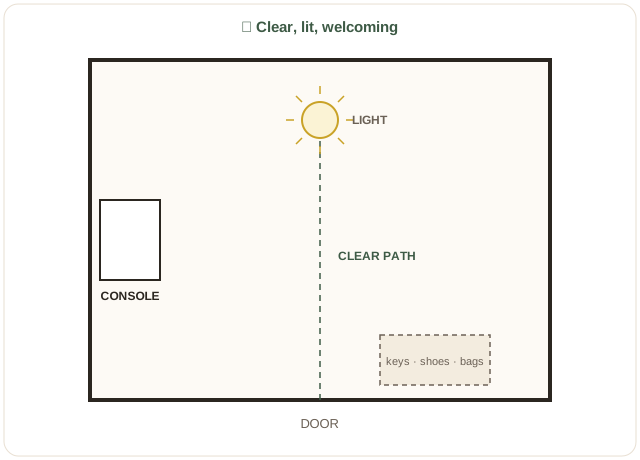
That side or garage entrance deserves a note, because in many homes it is the real front door. The entryway guide applies here just as much as at the formal front: somewhere to put shoes, a hook for keys, a surface for bags, and a clear step from "outside" to "inside." Without those, the garage entrance becomes a dumping ground — shoes, boxes, sports gear — and the household walks through clutter twice a day, every day. A small bench and a row of hooks by the garage door cost little and change the arrival completely.
The garage: a room, not a warehouse
The garage is the room most likely to swallow a household's clutter, and a full garage has a knock-on effect: the car ends up parked on the driveway permanently, the driveway fills up, and the approach to the house becomes a parking lot. The feng shui rule here is simple and practical — a garage should hold the car, or it should be honestly converted into something else. A garage that holds neither, because it is full of boxes nobody has opened in years, is serving nobody.
Clear it in stages: one wall at a time, keeping what is genuinely used and letting go of what is kept "just in case" for the third year running. Wall-mounted storage, ceiling racks, and labeled bins keep the floor clear, which matters because a clear garage floor is what lets you actually park in it. Keep the garage door itself in repair, too — a door that sticks, squeals, or will not close properly is both a security problem and a daily annoyance. And if the garage sits under or beside a bedroom, check the garage guide for how to handle the noise, fumes, and heat that arrangement can bring.
Surfaces, drainage, and the details
A driveway's surface is a safety issue before it is a beauty issue. Cracks, potholes, and loose pavers are trip hazards, especially at night and in wet weather, and they collect water that then freezes or breeds moss. Repair the worst sections first — the strip people actually walk on — and keep the surface swept and moss-free. Permeable paving, gravel grids, or a grass strip down the middle are worth considering when resurfacing: they drain better, look softer, and reduce the heat a solid asphalt slab throws back in summer.
Lighting along the driveway should mark the edges and the walk to the door, not flood the neighbours' windows. Low, downward-facing lights are enough; a single harsh floodlight over the garage makes the approach feel like a security checkpoint. Finally, keep bins, trailers, and project cars out of the direct sightline from the street to the door. They do not need to be hidden perfectly — a side screen or a tidy storage spot is enough — but when the first thing a visitor sees is the household's overflow, the house itself disappears behind it. A driveway that is repaired, lit, drained, and clear does not just look better. For the planting and path that frame it, see the front yard guide. It makes coming home feel like arriving, instead of parking.
Go deeper with the book
Feng Shui Made Simple covers every room this way — bedroom, living room, kitchen, office, entryway — with diagrams and a 7-day plan for doing the whole house.
Frequently asked questions
Should the driveway point straight at the front door?
Ideally not. A driveway that runs straight at the door pushes the car's line directly into the entrance. Break the line with a planted bed, a low wall, or a curve in the final meters before the house.
Is parking in front of the house bad feng shui?
Not by itself. The concern is proportion: when parking covers most of the front yard, the house starts to feel like an annex to the car park. Soften a wide driveway with planting strips, permeable pavers, or pots where it meets the house.
What if we always enter through the garage?
Then the garage door is your real front door — treat it that way. Give it a light, a mat, hooks for keys, and somewhere for shoes, so arrival does not mean walking through clutter twice a day.
How do I deal with a garage full of clutter?
Clear it one wall at a time, keeping only what is genuinely used, and use wall storage and labeled bins to keep the floor clear. A garage that cannot hold the car is serving nobody.
What is the most important driveway safety fix?
The walking surface and the lighting. Repair cracks and loose pavers on the strip people actually walk, and add low, downward-facing lights marking the edges and the walk to the door.